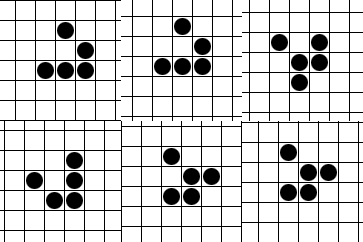
Game of Life is mathematic toy world that was invented by John Horton Conway in 1970. Game of Life is played on a grid of cells that are either dead or alive by simluating how the world evolves over a series of rounds. In each round cells die, survive, or are reborn depending on the number of neighbours they have. You can find out more about Game of Life by watching the video below or reading up on it in Wikipedia.
This file contains hidden or bidirectional Unicode text that may be interpreted or compiled differently than what appears below. To review, open the file in an editor that reveals hidden Unicode characters.
Learn more about bidirectional Unicode characters
| ------------------------------------------------------------------------------- | |
| Test set: org.neo4j.kernel.impl.nioneo.store.IdGeneratorRebuildFailureEmulationTest | |
| ------------------------------------------------------------------------------- | |
| Tests run: 20, Failures: 1, Errors: 9, Skipped: 0, Time elapsed: 92.186 sec <<< FAILURE! - in org.neo4j.kernel.impl.nioneo.store.IdGeneratorRebuildFailureEmulationTest | |
| neostore_propertystore_db(org.neo4j.kernel.impl.nioneo.store.IdGeneratorRebuildFailureEmulationTest$FailureDuringRebuild) Time elapsed: 91.414 sec <<< FAILURE! | |
| java.lang.AssertionError: makeStoreOk should have thrown UnderlyingStorageException | |
| at org.junit.Assert.fail(Assert.java:88) | |
| at org.neo4j.kernel.impl.nioneo.store.IdGeneratorRebuildFailureEmulationTest$FailureDuringRebuild.emulateFailureOnRebuildOf(IdGeneratorRebuildFailureEmulationTest.java:87) | |
| neostore_propertystore_db_strings(org.neo4j.kernel.impl.nioneo.store.IdGeneratorRebuildFailureEmulationTest$FailureDuringRebuild) Time elapsed: 0.005 |
This file contains hidden or bidirectional Unicode text that may be interpreted or compiled differently than what appears below. To review, open the file in an editor that reveals hidden Unicode characters.
Learn more about bidirectional Unicode characters
| = Master of Pancakes: Find Missing Recipe Ingredients = | |
| :neo4j-version: 2.0.0 | |
| :author: Stefan Plantikow | |
| :twitter: @boggle | |
| image::http://www.perfectpancake.info/wp-content/uploads/2013/04/pancakes.jpg[] | |
| Let's say you have a database of recipes and ingredients, as well as chefs and their current kitchen inventory. |
This proposoal follows three design principles:
-
Make it easy to understand the affected part of the graph in relationship to querying it (Rationale: Minimize mental effort for using constraints and indices)
-
Re-use existing concepts as much as possible (i.e. patterns and expressions) (Rationale: Minimize amount of new concepts that need to be learned)
-
Use the same imperative form as all existing update and schema commands (verb first, like in
CREATE INDEX) and try to use similiar syntax structure for both constraint and index creation
This file contains hidden or bidirectional Unicode text that may be interpreted or compiled differently than what appears below. To review, open the file in an editor that reveals hidden Unicode characters.
Learn more about bidirectional Unicode characters
| (in kleene logic K3) | |
| goal: NOT x OR y | |
| r.blocked x=exists(r.blocked) y=r.blocked <> true goal: x IMPLIES y suggestion: X AND NOT R.BLOCKED | |
| true true false false true AND NOT true => false | |
| false true true true true AND NOT false => true | |
| null false null true false AND NOT null => false !!! Here is the difference | |
| Here's another alternative for lukasiewicz logic L3, which defines implication as in K3 except null IMPLIES null => true |
This file contains hidden or bidirectional Unicode text that may be interpreted or compiled differently than what appears below. To review, open the file in an editor that reveals hidden Unicode characters.
Learn more about bidirectional Unicode characters
| import matryoshka.data.Fix | |
| import org.opencypher.spark.prototype.api.cyphertype.UnFixable.RecursiveExtractor | |
| import matryoshka.Recursive | |
| import shapeless.ops.hlist.Tupler | |
| import scala.language.higherKinds | |
| import scala.reflect.ClassTag | |
| import scalaz.Functor |
OlderNewer
