- http://efcasado.github.io/riak-core_intro/
- http://basho.com/statebox-an-eventually-consistent-data-model-for-erlang-and-riak/
- http://dancres.github.io/Pages/
- http://www.erlang-factory.com/conference/SFBay2010/speakers/AndyGross
- http://thinkdistributed.io
- http://christophermeiklejohn.com/distributed/sycstems/2013/07/12/readings-in-distributed-systems.html
- http://christophermeiklejohn.com/crdt/2014/07/22/readings-in-crdts.html
- http://www.aosabook.org/en/riak.html
- 1 2lb bag good AP flour
- 1 active dry yeast packet
- 25 grams salt
- 600 grams water (just over 2 cups)
Mix the salt, yeast, water and about 3/4 of the flour with the paddle attachment (on your stand mixer, or you can try it by hand which I've never done) for about a minute until it is all mixed, it should be pretty loose.
Let it sit, covered, for about 20 minutes.
Knead it on low for 5-7 minutes, until it starts to even out in texture, then start adding the rest of the flour until the dough starts to pull away from the bowl. It should still be pretty wet though. Knead for another 5-7 minutes on med-low, let it rest again for 20 minutes, then remove it to a floured bench, work it with your hands, shape it, and cut it into 4-5 even sized balls.
- You can store a price in a floating point variable.
- All currencies are subdivided in 1/100th units (like US dollar/cents, euro/eurocents etc.).
- All currencies are subdivided in decimal units (like dinar/fils)
- All currencies currently in circulation are subdivided in decimal units. (to exclude shillings, pennies) (counter-example: MGA)
- All currencies are subdivided. (counter-examples: KRW, COP, JPY... Or subdivisions can be deprecated.)
- Prices can't have more precision than the smaller sub-unit of the currency. (e.g. gas prices)
- For any currency you can have a price of 1. (ZWL)
- Every country has its own currency. (EUR is the best example, but also Franc CFA, etc.)
| -module(hilbert). | |
| -export([curve/1, curve/7, point_to_hilbert/3]). | |
| -define(HILBERTMAP, [ | |
| {a, [{{0,0},{0,d}}, {{0,1},{1,a}}, {{1,0},{3,b}}, {{1,1},{2,a}}]}, | |
| {b, [{{0,0},{2,b}}, {{0,1},{1,b}}, {{1,0},{3,a}}, {{1,1},{0,c}}]}, | |
| {c, [{{0,0},{2,c}}, {{0,1},{3,d}}, {{1,0},{1,c}}, {{1,1},{0,b}}]}, | |
| {d, [{{0,0},{0,a}}, {{0,1},{3,c}}, {{1,0},{1,d}}, {{1,1},{2,d}}]} | |
| ]). |
| ''' | |
| Description: dashboard/* primarily powers the APIs requires to support the growth dashboards. | |
| @author: sureshsaggar | |
| ''' | |
| #!/usr/bin/env python | |
| from httpserver import * | |
| from werkzeug.routing import * | |
| import time | |
| import redis |
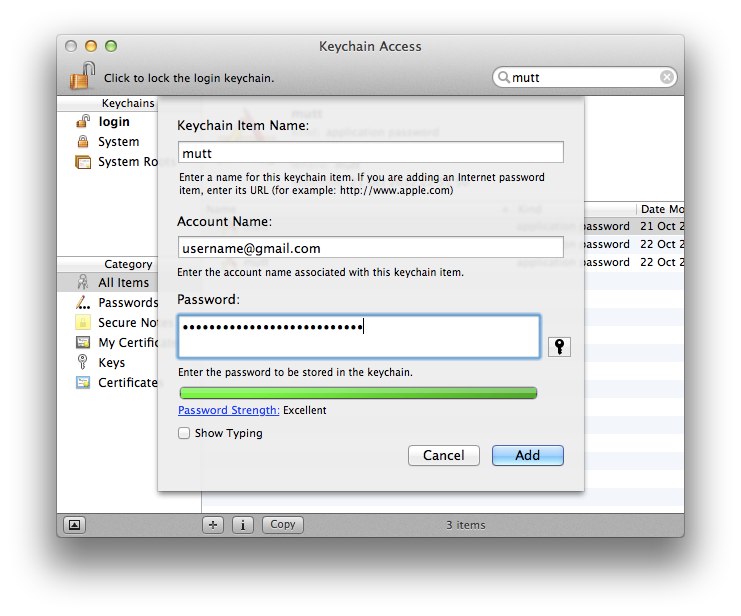
Create a new keychain item, enter the Keychain Item Name as mutt, the Account Name as your gmail email address and then enter your password, then add the keychain item.
If you're using Google 2-step auth, you'll need to generate an Application-specific password from your Google Account settings and enter that as the password.
| import sqlite3 | |
| import pdb | |
| conn = sqlite3.connect('AddressBook.sqlitedb') | |
| c = conn.cursor() | |
| sql = "select ABMultiValue.value, ABPerson.ROWID from ABPerson,ABMultiValue where ABMultiValue.record_id=ABPerson.ROWID" | |
| ins = "update ABMultiValue set value='%s' where record_id=%s" | |
| l = [9,12] | |
| prefix = ['08','09','06','05','03'] | |
| c.execute(sql) | |
| res = c.fetchall() |
| -module(timeit). | |
| -compile(export_all). | |
| %% @doc Dynamically add timing to MFA. There are various types of | |
| %% timing. | |
| %% | |
| %% all - time latency of all calls to MFA | |
| %% | |
| %% {sample, N, Max} - sample every N calls and stop sampling after Max | |
| %% |
| %% Given the parsed HTML tree in the following format: | |
| %% | |
| %% Types HTML = [Element] | |
| %% Element = {Tag, [Attribute], [Element | Text]} | |
| %% Tag = atom() % e.g. 'a', 'pre', 'p' | |
| %% Attribute = {Name, Value} | |
| %% Name = atom() | |
| %% Value = string() | |
| %% Text = iolist() | |
| %% |