Reference: http://www.codeproject.com/Articles/33052/Visual-Representation-of-SQL-Joins

Dmitri K korya

korya
/ Visual SQL Joins.md
Created
January 26, 2016 22:33
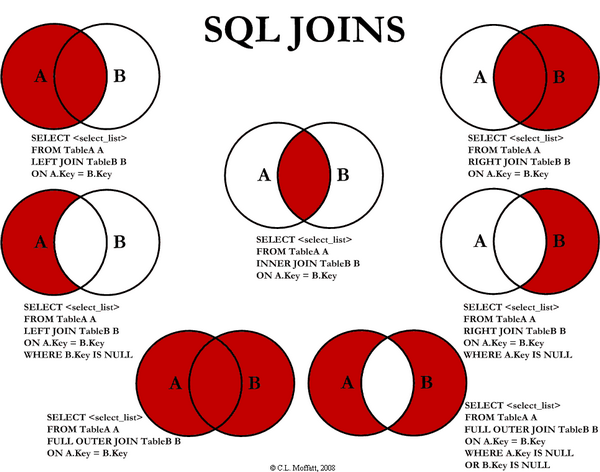
korya
/ bug-in-design-zayin-in-debug.md
Created
February 11, 2016 17:16
Bug in design, zayin in debug (explanation)
"Bug ba-design, zayin ba-debug" (Hebrew: באג בדיזיין, זין בדיבאג)
I feel sorry for the majority here - non-Israelis who can't get this joke - because it's truly one of the funniest things I've heard in a while. It is a clever play on words, even though it mixes English and Hebrew and isn't all that grammatically correct (it's not even a complete sentence). Remarkably, it is a fact of life as well.
The word zayin (slang for "dick" in Hebrew, pronounced similarly to "sign" in "design") has some of the connotations the word shit has in English. The phrase, therefore, can be translated as "A bug in the design (is) shit in the debugging" or "A bug in the design (is) shit to debug". Another way to interpret this usage of "zayin" is as a shorthand for "lekabel zayin" (lit. "to get dick" - to get screwed; carries very rude connotations), and then a loose translation could be "If there's a bug in the design, you get screwed when you debug".
The original writeup above (which is no longer with us) said this was a com
This file contains hidden or bidirectional Unicode text that may be interpreted or compiled differently than what appears below. To review, open the file in an editor that reveals hidden Unicode characters.
Learn more about bidirectional Unicode characters
| <html> | |
| <head> | |
| <title> | |
| Bit Twiddling Hacks | |
| </title> | |
| </head> | |
| <body> |
This file contains hidden or bidirectional Unicode text that may be interpreted or compiled differently than what appears below. To review, open the file in an editor that reveals hidden Unicode characters.
Learn more about bidirectional Unicode characters
| // Based on https://github.com/enepomnyaschih/jwcanvas/blob/master/jwidget/public/jwcanvas/transform.js | |
| class Transform { | |
| constructor() { | |
| // / a c e \ | |
| // | b d f | => [a, b, c, d, e, f] | |
| // \ 0 0 1 / | |
| this.matrix = [1, 0, 0, 1, 0, 0]; | |
| } |
korya
/ handler.js
Created
April 11, 2016 12:45
— forked from ThisIsMissEm/handler.js
The better way to execute Go on Amazon Lambda (see: http://blog.0x82.com/2014/11/24/aws-lambda-functions-in-go/)
This file contains hidden or bidirectional Unicode text that may be interpreted or compiled differently than what appears below. To review, open the file in an editor that reveals hidden Unicode characters.
Learn more about bidirectional Unicode characters
| var child_process = require('child_process'); | |
| exports.handler = function(event, context) { | |
| var proc = spawn('./test', [ JSON.stringify(event) ], { stdio: 'inherit' }); | |
| proc.on('close', function(code){ | |
| if(code !== 0) { | |
| return context.done(new Error("Process exited with non-zero status code")); | |
| } |
Functions flushing browser's "reflow" queue:
offsetTop,offsetLeft,offsetWidth,offsetHeightscrollTop/Left/Width/HeightclientTop/Left/Width/HeightgetComputedStyle(), orcurrentStylein IE
All of these above are essentially requesting style information about a node, and any time you do it, the browser has to give you the most up-to-date value. In order to do so, it needs to apply all scheduled changes, flush the queue, bite the bullet and do the reflow.
sci-hub.io is down. Use the IP address directly:
# echo '31.184.194.81 sci-hub.io' >> /etc/hosts
# echo '31.184.194.81 sci-hub.org' >> /etc/hosts
# echo '31.184.194.81 sci-hub.club' >> /etc/hosts
Alternative option: scihub22266oqcxt.onion
3-state checkbox made with CSS:
This file contains hidden or bidirectional Unicode text that may be interpreted or compiled differently than what appears below. To review, open the file in an editor that reveals hidden Unicode characters.
Learn more about bidirectional Unicode characters
| getLatestVersion() { | |
| local path="$1" | |
| aws s3api list-object-versions --output json --bucket iguides.plntr.ca --prefix "$path" | jq '.Versions[0].VersionId' -r | |
| } | |
| filename=[remove-file-name] | |
| path="ig8OKNNO6IIPDD1/gallery/${filename}" | |
| versionId="$(getLatestVersion "$path")" | |
| echo "filename: $filename" |
korya
/ ddd-in-golang.markdown
Created
December 9, 2016 13:33
— forked from abdullin/ddd-in-golang.markdown
DDD in golang
This is my response to an email asking about Domain-Driven Design in golang project.
Thank you for getting in touch. Below you will find my thoughts on how golang works with DDD, changing it. This is merely a perception of how things worked out for us in a single project.
That project has a relatively well-known domain. My colleagues on this project are very knowledgeable, thoughtful and invested in quality design. The story spelled out below is a result of countless hours spent discussing and refining the approach.
Conclusions could be very different, if there was a different project, team or a story-teller.