
When making this website, i wanted a simple, reasonable way to make it look good on most displays. Not counting any minimization techniques, the following 58 bytes worked well for me:
main {
  max-width: 38rem;
  padding: 2rem;
  margin: auto;
}
| import time | |
| from http.server import BaseHTTPRequestHandler, HTTPServer | |
| HOST_NAME = 'localhost' | |
| PORT_NUMBER = 9000 | |
| class MyHandler(BaseHTTPRequestHandler): | |
| def do_HEAD(self): | |
| self.send_response(200) |

| /* | |
| After purchasing a humble book bundle, go to your download page for that bundle. | |
| Open a console window for the page and paste in the below javascript | |
| */ | |
| function getTitle() { | |
| var re = /^Humble\ Book\ Bundle\:\ (.*)\ \(/g; | |
| return re.exec(document.title)[1]; | |
| } |


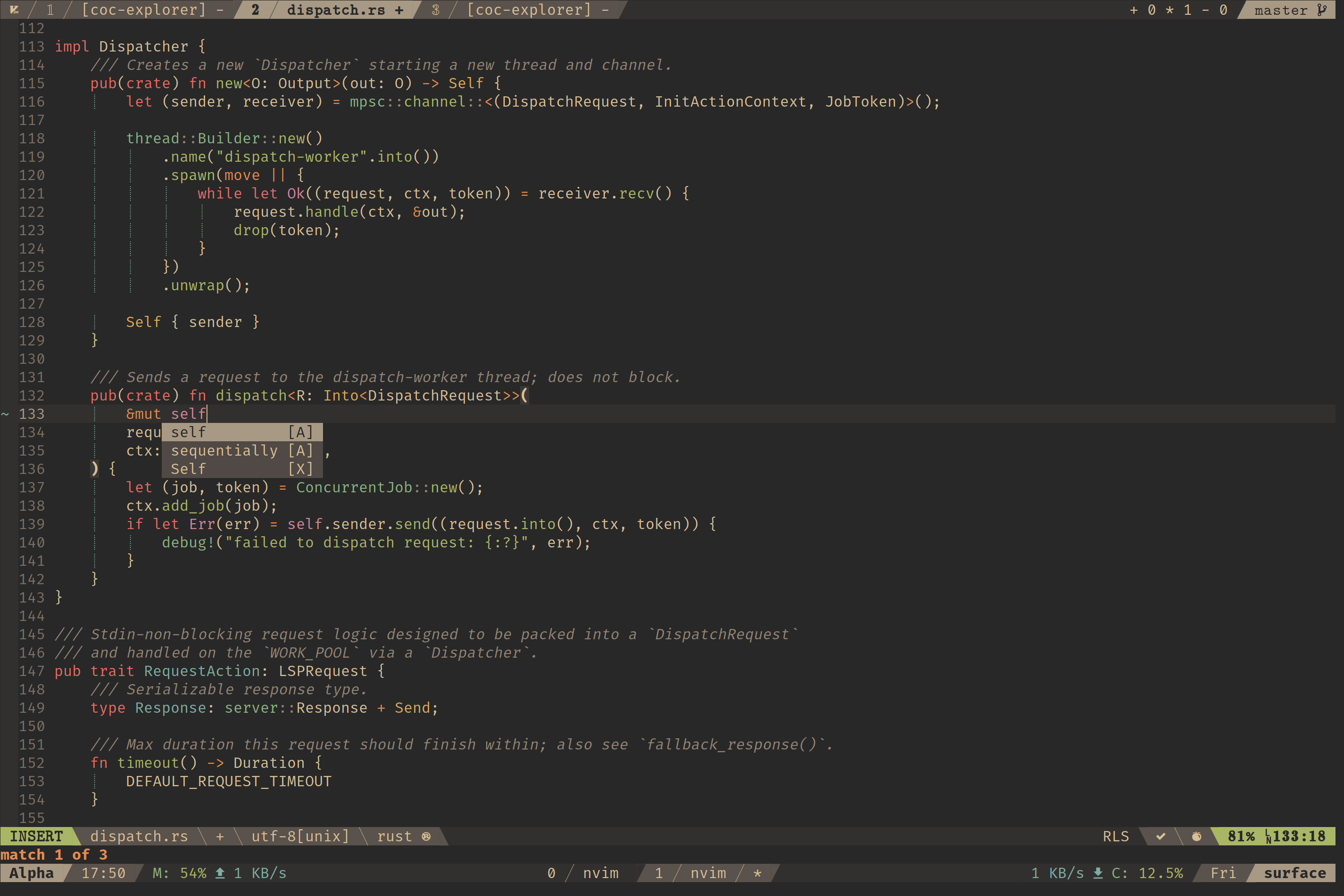
First of all, install a nerd font, and apply it: nerd font

| # vim:fileencoding=utf-8:ft=conf:foldmethod=marker | |
| #: Fonts {{{ | |
| #: kitty has very powerful font management. You can configure | |
| #: individual font faces and even specify special fonts for particular | |
| #: characters. | |
| font_family JetBrains Mono Medium | |
| bold_font JetBrains Mono Bold |

| " Language Specific scratch buffers with date | |
| " --------------------------------------------------------------------------------- | |
| function! s:DScratch(scratch_ft) | |
| let scratch_dir = '~/Dropbox/scratch/buffers' | |
| let scratch_date = strftime('%Y%m%d') | |
| let scratch_file = 'scratch-'. scratch_date . '.' . a:scratch_ft | |
| let scratch_buf = bufnr(scratch_file) | |
| if scratch_buf == -1 | |
| exe 'split ' . scratch_dir . '/' . scratch_file |

It's because the cedilla module isn't loaded by default when the locale is set to en, so) you have to change the configuration files for gtk to add them:
sudo vim /usr/lib/x86_64-linux-gnu/gtk-3.0/3.0.0/immodules.cache
sudo vim /usr/lib/x86_64-linux-gnu/gtk-2.0/2.10.0/immodules.cache
On both, find the lines starting with "cedilla" "Cedilla" and add :en to the line. Something like this:

| #!/usr/bin/env python | |
| import http.server | |
| import ssl | |
| # Create certifcate and key: https://github.com/stephenbradshaw/pentesting_stuff/blob/master/example_code/create_self_signed_https_certs.py | |
| context = ssl.SSLContext(ssl.PROTOCOL_TLS_SERVER) | |
| context.load_cert_chain(certfile="https_self_signed_cert.pem", keyfile="https_self_signed_key.pem") | |
| httpd = http.server.HTTPServer(('127.0.0.1', 443), http.server.SimpleHTTPRequestHandler) |

| from argparse import ArgumentDefaultsHelpFormatter, ArgumentParser | |
| from sklearn.datasets import make_classification | |
| from sklearn.decomposition import PCA | |
| from sklearn.manifold import LocallyLinearEmbedding | |
| from sklearn.linear_model import LogisticRegression | |
| from sklearn.svm import SVC | |
| from sklearn.ensemble import RandomForestClassifier | |
| from sklearn.model_selection import train_test_split | |
| from sklearn.metrics import accuracy_score | |
| from gooey import Gooey |

I want Microsoft to do better, want Windows to be a decent development platform-and yet, I constantly see Microsoft playing the open source game: advertising how open-source and developer friendly they are - only to crush developers under the heel of the corporate behemoth's boot.
The people who work at Microsoft are amazing, kind, talented individuals. This is aimed at the company's leadership, who I feel has on many occassions crushed myself and other developers under. It's a plea for help.
You probably haven't heard of it before, but if you've ever used win32 API bindings in C#, C++, Rust, or other languages, odds are they were generated from a repository called microsoft/win32metadata.