Excerpts, notes and newspaper clippings circa 1869 - MEGA² IV/19
Timm Grassman


Excerpts, notes and newspaper clippings circa 1869 - MEGA² IV/19
Timm Grassman
by Izabella Tabarovsky
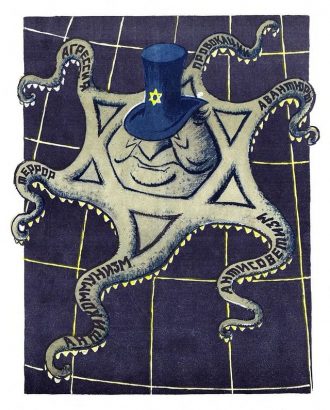
Anti-Zionist caricature from the Soviet magazine, Krokodil, 1972.
For many decades, virulently antisemitic forms of 'anti-Zionism' were central to the cold war propaganda of the Communist states. In this powerful essay Izabella Tabarovsky not only lays bare the entire shameful story of Soviet Judeophobia but shows us that, to quote William Faulkner, 'the past is not dead, it is not even past'.
This essay is also available in Polish.
Franz Petry
Doctor of Political Science, Jena
The author of this book, Dr. Franz Petry, did not live to see the publication of his book. - After Petry had received his doctorate in May 1914, he hurried to take up arms at the outbreak of the war, but soon had to leave the service again due to serious illness and take a stay in Merano and Abbazia for several months. When he visited me here after his recovery in June of this year, he informed me that he would be undergoing military training in his hometown of Frankfurt a. M. for some time after July 1, but that he hoped to return to the front soon. He followed my advice to use this training time for printing and correcting his doctoral thesis, but wrote me on August 20 that he had received orders to report to a battery in Zossen and for this reason could not personally make possible the final completion and publication of his thesis. & He asked me to take care of the last formalitie
Preliminary Remarks.
The present paper is mainly concerned with the ontological aspects of the controversy about internal and external relations that has been carried on between F. H. Bradley (1846-1924) and B.Russell (1872-1970). Since this controversy, and with it the philosophical environment in which it developed, as well as at least one of its two protagonists, have now been almost completely forgotten, for good reasons, it is not so much the controversy itself that can justify the attention given to it here. Rather, it is the consequences associated with this con troverse that suggest its consideration.
Two of these consequences are particularly noteworthy. One consists in the conviction, based on the supposed outcome of the controversy, that so-called 'monistic' theories of reality must be regarded as unsuitable, on logical grounds alone, for providing consistent models for the interpretation of what is. The second consequence consists in the assumption, related to the first one about some misunderst
Franz Heilgendorff
The questionable thesis of a progressive popularization in Capital and its consequences
Apart from the first book[^1], Marx's Capital remained unfinished. However, it seems to have become a commonplace to understand Marx's main work as a torso, which in turn determines the perspective of reception right up to popularizing introductions. It assumes that Marx did not understand himself and left behind a work that is anything other than "a completed, coherent theory that has been thought through to its conclusion" (Bruschi et al. 2012, 13). In particular, the "New Marx Reading" following Hans-Georg Backhaus (1969) directs the focus to the first three chapters, because this new approach is "particularly clear" there (Heinrich 2005b, 11). The questions that preoccupy and often divide readers of Capital revolve around the following points: "What is value all about, and where exactly does it come from? Is Capital also a history of capitalism? Why does Marx begin his analysis with com