
- node.js
- Installation paths: use one of these techniques to install node and npm without having to sudo.
- Node.js HOWTO: Install Node+NPM as user (not root) under Unix OSes
- Felix's Node.js Guide
- Creating a REST API using Node.js, Express, and MongoDB
- Node Cellar Sample Application with Backbone.js, Twitter Bootstrap, Node.js, Express, and MongoDB
- JavaScript Event Loop
- Node.js for PHP programmers

dypsilon
/ backendDevelopmentBookmarks.md
Last active
October 9, 2025 13:51
Backend Engineering Bookmarks

aaronjensen
/ all_cache_key.rb
Created
July 23, 2013 14:47
This file contains hidden or bidirectional Unicode text that may be interpreted or compiled differently than what appears below. To review, open the file in an editor that reveals hidden Unicode characters.
Learn more about bidirectional Unicode characters
| module AllCacheKey | |
| extend ActiveSupport::Concern | |
| module ClassMethods | |
| def cache_key | |
| pluck("COUNT(*)", "MAX(updated_at)").flatten.map(&:to_i).join("-") | |
| end | |
| end | |
| end |

jbenet
/ simple-git-branching-model.md
Last active
December 7, 2025 19:59
a simple git branching model

by Gavin Lazar Suntop @gvn
I love clean code. There, I said it. I pride myself on passing strict linting standards and keeping my code easy to read. It's not just a personal proclivity, but a choice I hope benefits other developers.
My general experience with teams has been that code style is something people care about and have strong personal preferences. Typically, at some point people get tired of dealing with inconsistency and a standardization meeting is called. This is, of course, an important discussion to have. The problem that tends to occur is either lack of documentation or lack of enforcement of the agreed upon style. Additionally, new team members or contributors may not have access to a clear set of rules.

niquola
/ list.md
Last active
May 20, 2018 04:52
Must Read from Ravil Bayramgalin (https://github.com/brainopia) + my small adds :)
Concepts-Techniques-Models-Computer-Programming CMT это известная книжка CMT, за которой слава закрепилась не хуже чем у SICP
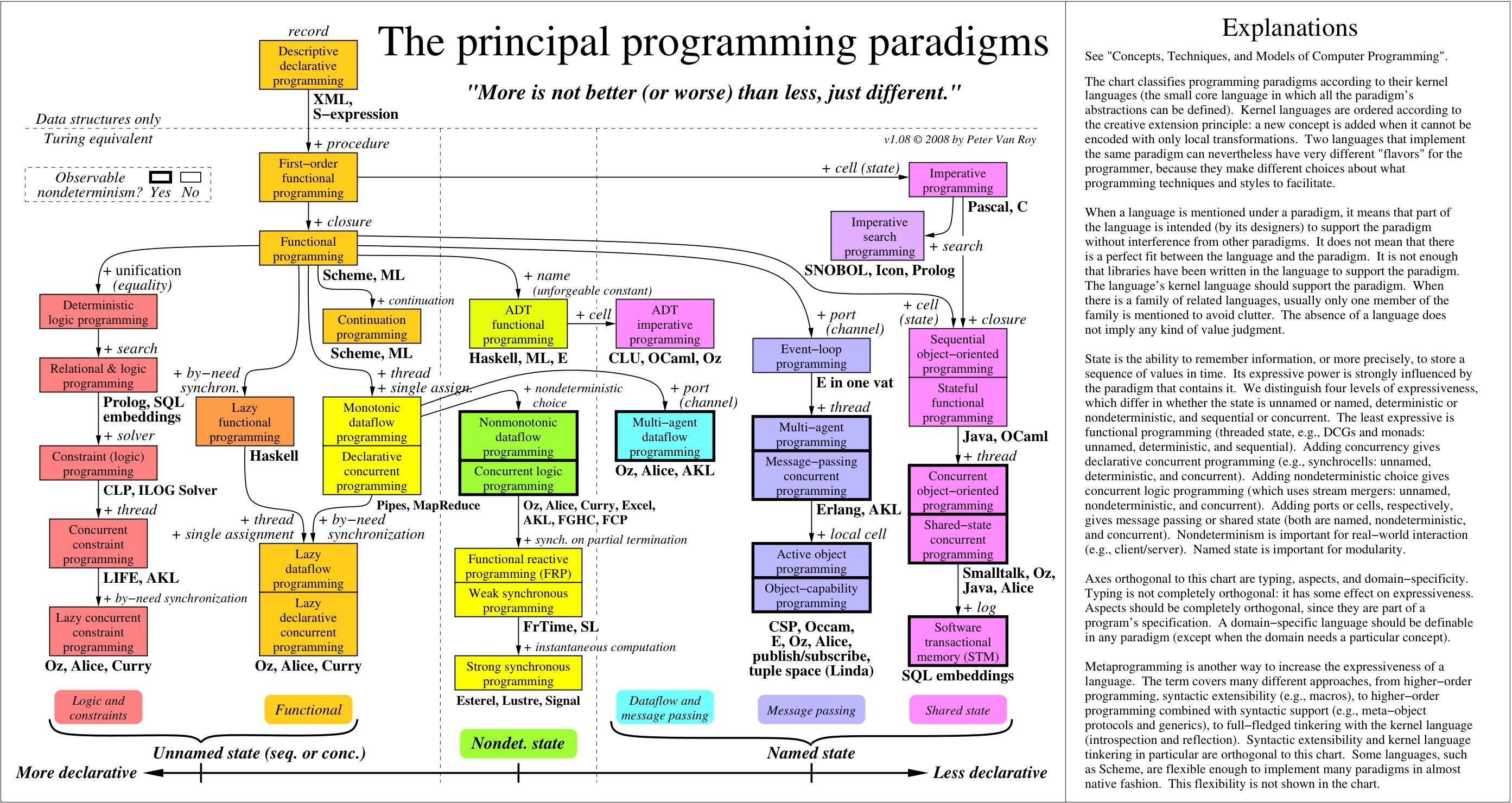
это из этой книжки классификация различных парадигм Если присмотришься, то увидишь, что Oz поддерживает большинство вариаций (с этой целью его и конструировали, чтобы можно было наглядно продемонстрировать различные подходы в одном языке)

Try these rules:
(in www.domain.com's server block)
rewrite ^/$ http://domain.com permanent break;
rewrite ^/main(.*)$ http://domain.com$1 permanent break;

speric
/ poodir-notes.md
Last active
March 25, 2025 01:06
Notes From "Practical Object-Oriented Design In Ruby" by Sandi Metz
The purpose of design is to allow you to do design later, and it's primary goal is to reduce the cost of change.
- Single Responsibility Principle: a class should have only a single responsibility
- Open-Closed Principle: Software entities should be open for extension, but closed for modification (inherit instead of modifying existing classes).
- Liskov Substitution: Objects in a program should be replaceable with instances of their subtypes without altering the correctness of that program.
- Interface Segregation: Many client-specific interfaces are better than one general-purpose interface.

shageman
/ Count the lines of Ruby code in your app
Created
April 22, 2014 16:39
This file contains hidden or bidirectional Unicode text that may be interpreted or compiled differently than what appears below. To review, open the file in an editor that reveals hidden Unicode characters.
Learn more about bidirectional Unicode characters
| #Count the lines of Ruby code in your app | |
| find . -iname "*.rb" -type f -exec cat {} \; | wc -l |

conorh
/ nginx.conf
Created
April 22, 2015 15:05
Using Nginx as a caching proxy for Refile with Ruby on Rails
This file contains hidden or bidirectional Unicode text that may be interpreted or compiled differently than what appears below. To review, open the file in an editor that reveals hidden Unicode characters.
Learn more about bidirectional Unicode characters
| http { | |
| ... | |
| proxy_cache_path /data/perch.squaremill.com/shared/image_cache levels=1:2 keys_zone=images:10m; | |
| ... | |
| } |

csamsel
/ Enhanced NGINX logstash parser
Last active
February 5, 2022 14:54
Enhanced NGINX logstash parser to include upstream response time and request length fields
This file contains hidden or bidirectional Unicode text that may be interpreted or compiled differently than what appears below. To review, open the file in an editor that reveals hidden Unicode characters.
Learn more about bidirectional Unicode characters
| Enhanced NGINX logstash parser: | |
| NGINX log format: | |
| log_format enhanced '$remote_addr - $remote_user [$time_local] "$request" $status $body_bytes_sent $request_length "$http_referer" "$http_user_agent" $request_time $upstream_response_time'; | |
| access_log /var/log/nginx/access.log enhanced; | |
| error_log /var/log/nginx/error.log; | |
| logstash pattern (/opt/logstash/pattern/nginx): |