Skip to content

Instantly share code, notes, and snippets.

View themacmarketer's full-sized avatar

eBizGrow themacmarketer

View GitHub Profile
@rudeboybert
rudeboybert / import_calendar_into_R.R
Last active April 15, 2024 16:20
Code to import a Google Calendar, macOS Calendar, or Outlook calendar .ics file into R
library(ggplot2)
library(dplyr)
library(lubridate)
library(ical)
# For a screencast demo on creating a calendar and exporting it to .ics file format
# see this video: https://youtu.be/vLlR4lBWAoc
# Locate your .ics calendar file on your computer and change what's in quotation marks
calendar_data <- "192.ics" %>%
@tanaikech
tanaikech / submit.md
Created June 24, 2020 04:48
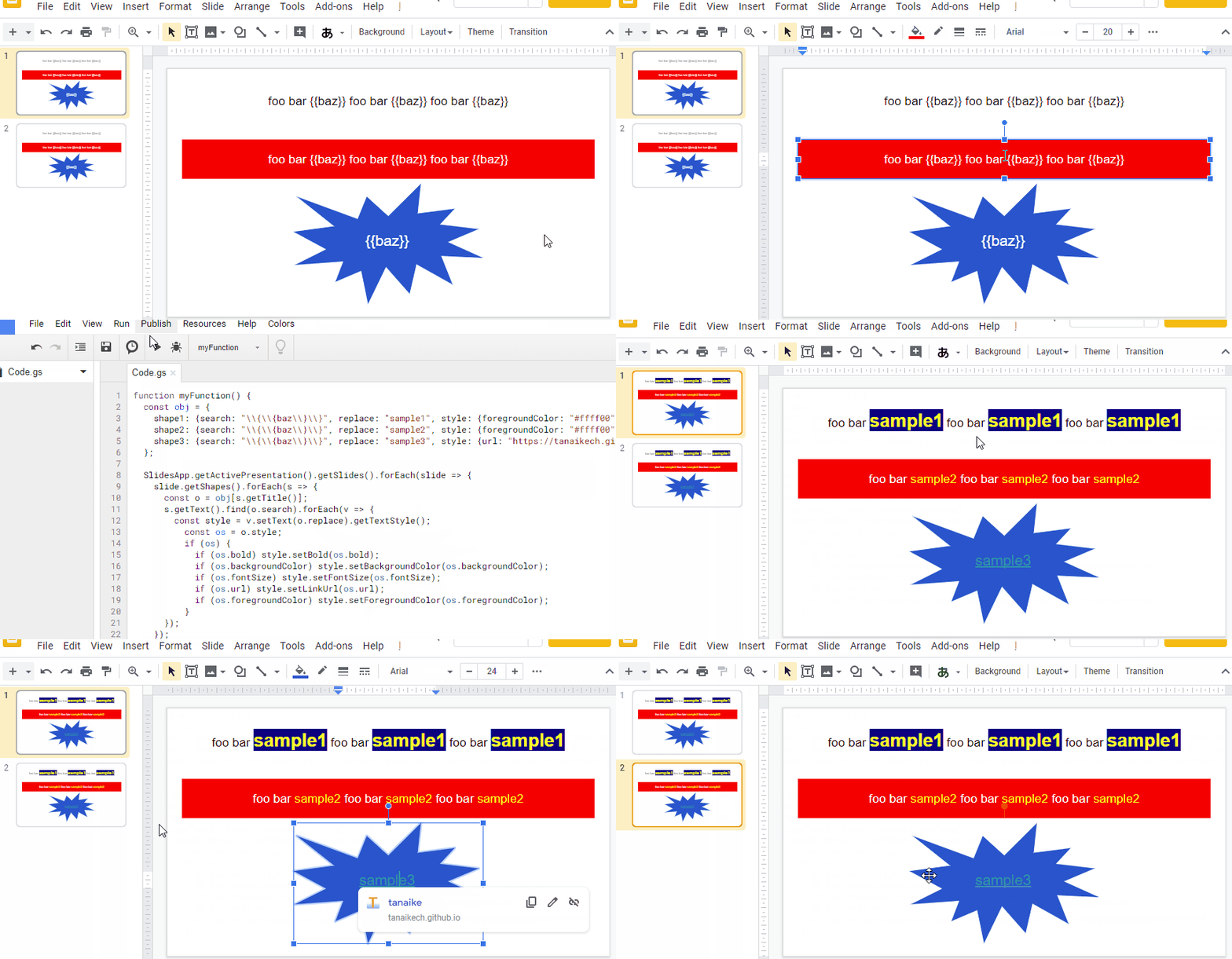
Managing Texts on Google Slides using Google Apps Script

Managing Texts on Google Slides using Google Apps Script

This is a sample script for managing the texts on Google Slides using Google Apps Script. Recently, I got the request like this. I published this here, because I thought that this might be also useful for other users.

Demo

In this demonstration, the text of {{baz}} on Google Slides are searched and replaced to other text, and also, the text style is changed.

LLM Wiki

A pattern for building personal knowledge bases using LLMs.

This is an idea file, it is designed to be copy pasted to your own LLM Agent (e.g. OpenAI Codex, Claude Code, OpenCode / Pi, or etc.). Its goal is to communicate the high level idea, but your agent will build out the specifics in collaboration with you.

The core idea

Most people's experience with LLMs and documents looks like RAG: you upload a collection of files, the LLM retrieves relevant chunks at query time, and generates an answer. This works, but the LLM is rediscovering knowledge from scratch on every question. There's no accumulation. Ask a subtle question that requires synthesizing five documents, and the LLM has to find and piece together the relevant fragments every time. Nothing is built up. NotebookLM, ChatGPT file uploads, and most RAG systems work this way.