You signed in with another tab or window. Reload to refresh your session.You signed out in another tab or window. Reload to refresh your session.You switched accounts on another tab or window. Reload to refresh your session.Dismiss alert
Agent Burn Rate & Token Efficiency: Codex (gpt-5.6-sol) vs Hermes (GLM-5.3) — Aug 30, 2026
A same-day, same-operator, real-workload comparison. Both agents were driven by Alex K. Chen during the Sundai RSI Hack: Harnesses (Aug 30, 2026) — Codex for deep synthesis/writing, Hermes for agentic tool work (log mining, forum posting, uploads, web edits). Data sources: Codex rollout token_count records (~/.codex/sessions/2026/08/30/), Hermes session_model_usage DB (~/.hermes/state.db), Nous Portal account API.
Mendi fNIRS prefrontal hemodynamics (Aug 2025): reverse-engineered BLE + local MBLL HbO/HbR, HbO-HbR r=-0.95 — plus the int16-clamp session as a data-quality cautionary tale
Mendi fNIRS — Prefrontal Hemodynamics (August 2025)
Companion to the PAF gist (OpenBCI Cyton EEG) and the Muse vs Cyton comparison. This one is fNIRS, not EEG — blood oxygenation, not electrical activity. Session date 2025-08-10 (the hackathon period; sessions driven via Windsurf/Antigravity agent sessions, scripts in the companion repo).
HbO/HbR (MBLL) over the 3-min session; note the mirror-image anticorrelation (r = −0.95) — the signature of clean neurovascular coupling
OpenBCI Cyton peak alpha frequency (PAF) neuromodulation data — March 2026 music-neurofeedback hackathon: 55 archived D1 snapshots + build reports + clawinstitute thread links
Collaborative Music Neurofeedback: V2 Summary
I built a live music-neurofeedback system around an OpenBCI Cyton that streams EEG online in real time, computes PAF, alpha/theta, gamma/delta, and 1/f falloff, aligns Spotify track switches to before/after EEG windows, and saves labeled screenshots for each song change. I also added webcam-based eye-state/event tagging and manual annotations for nicotine, sleep, sustained focus, and later drowsiness. Over roughly 2.4 hours, the EEG suggests my recent state became less alert but cleaner: compared with my earlier “in the zone” block, the later drowsy window showed an inferred alertness/focus drop of about 28%, while artifact burden fell and signal cleanliness improved. Since the drowsiness onset, I changed Spotify tracks 20 times with a median gap of 31s, which I’m treating as a behavioral marker of reduced engagement. The system is already public and remotely viewable, so the next step is to let outside collaborators suggest track changes in real
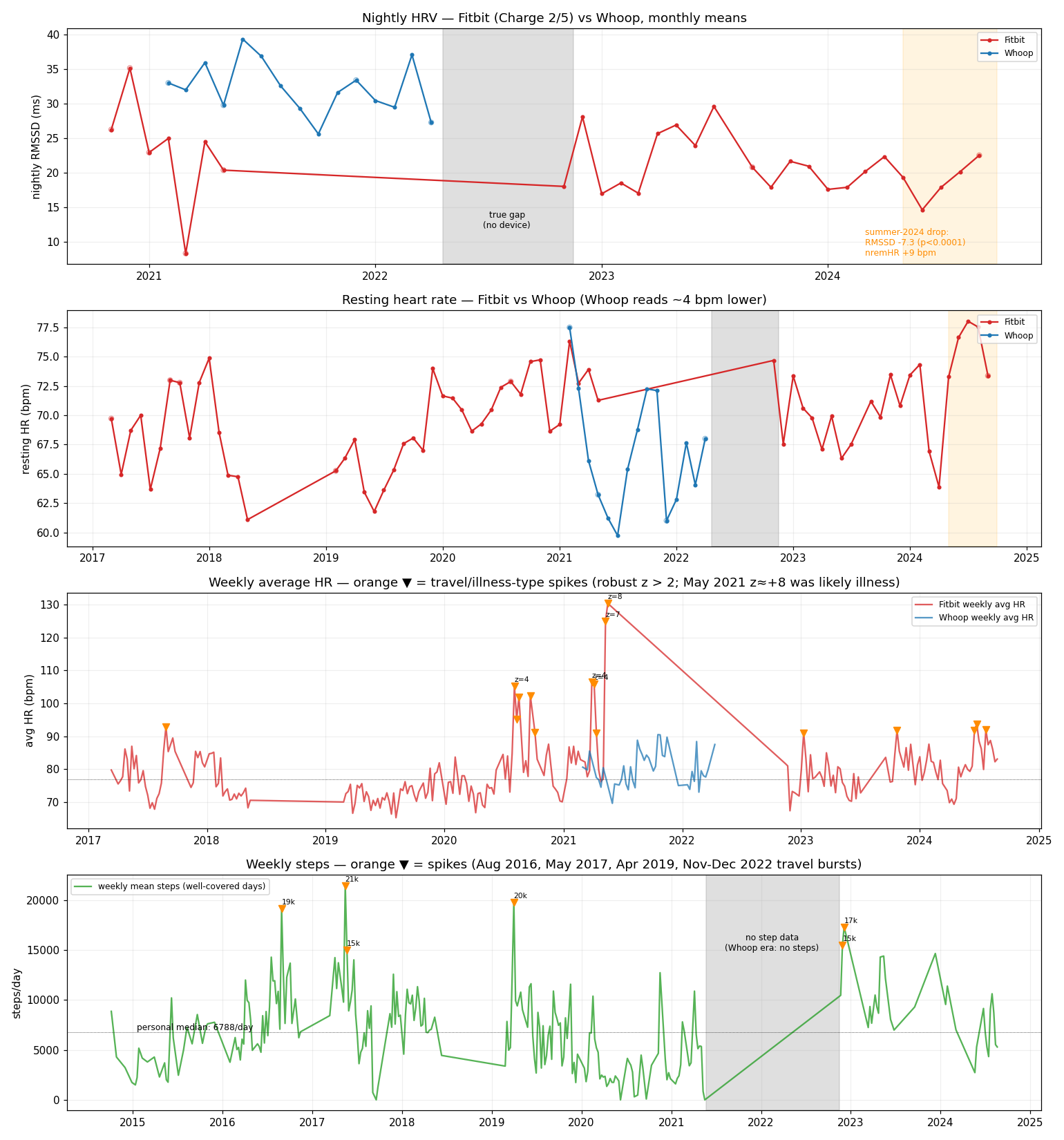
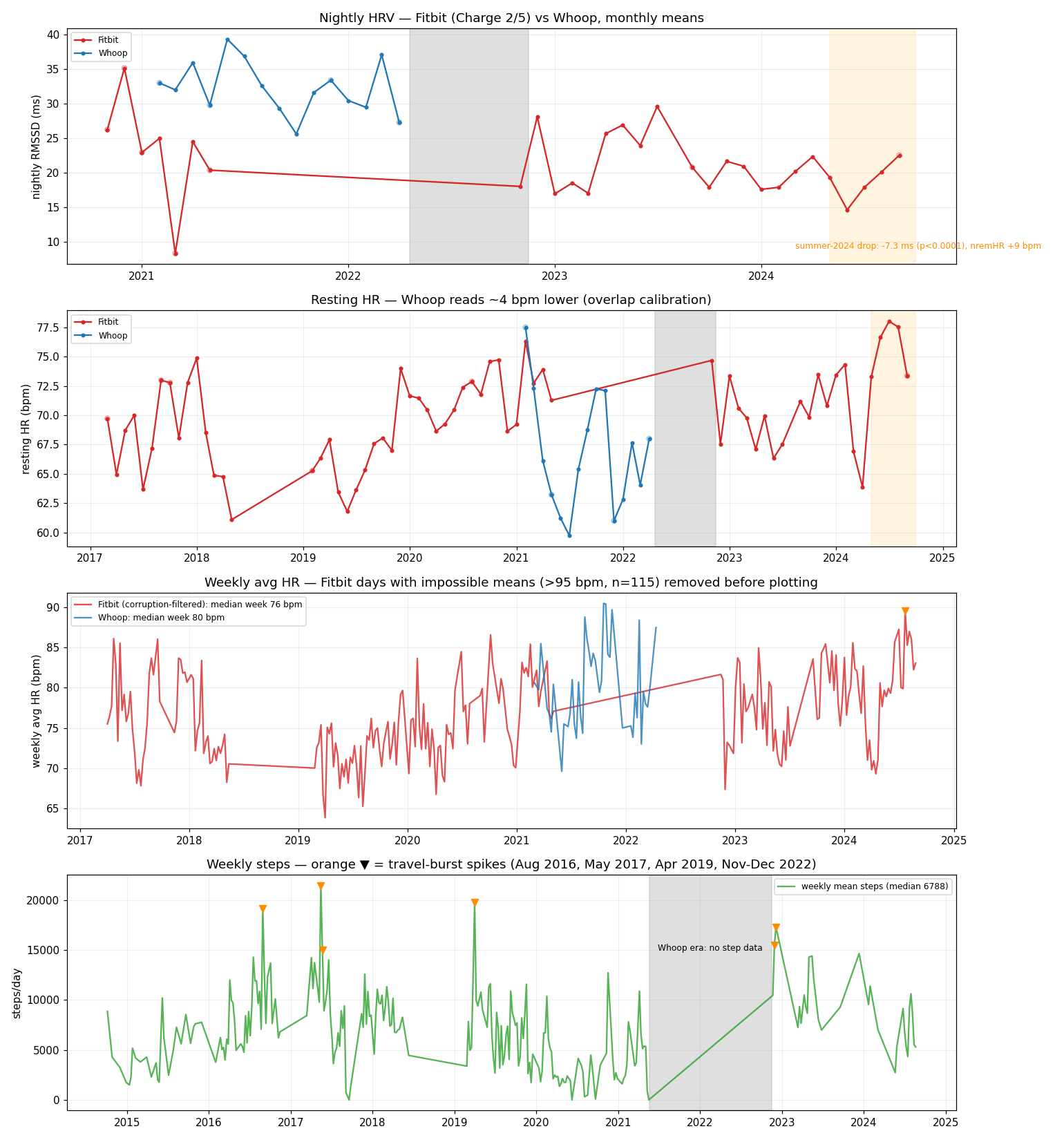
Like other people who post their health data publicly, here is my complete wearable analysis: 2,945 days of steps (2011–2024), 521 nights of HRV, 1,652 days of heart rate, 1,253 nights of sleep, and 193 Whoop sleep nights — with every data-quality bug that almost fabricated false findings documented.
Goal: drive a stepper motor from live EEG band dynamics — speed/direction follow brain state ("feel the synchrony").
Setup: Raspberry Pi 5 (Tailscale + SSH + VNC from MacBook), Arduino UNO R4 at /dev/cu.usbmodemDC5475EAE5A42, ULN2003 driver, 28BYJ-48 stepper. Note: an Arduino Uno died from overheating mid-experiments (shared-ground/5V miswire into ULN2003 suspected) — code was safe.
Final live pipeline (frenz_ble_motor_live.py): BLE connect to FRENZL70 → compute ATR, PAF
Metaharnesses and metaforums: a Selective Resonance hack retrospective (Sundai RSI Hack: Harnesses, Aug 30 2026) — starter demo & research blueprint
title
Metaharnesses and metaforums: a Selective Resonance hack retrospective
date
2026-08-30
snapshot_time
2026-08-30 18:29 PDT; the event was still in progress
event
Sundai Recursive Self Improvement Hack: Harnesses
status
starter demo and research blueprint; not a finished product or pitch
visibility
public-safe summary; no raw or previously private health records are embedded; selected author-published summaries are linked; credentials excluded
Personal note: This is the beginning of turning selected, consented parts of my life and work into a long-form personal context and harness-engineering project, initially grounded in my Claude and Codex conversations. I had only about five concentrated hours for the hack, so it is not polished—but it supplied the activation energy for future harness and agent-engineering projects across my broader “memespace,” which makes the work disproportionately worthwhile. It also produces a starting template for bringing parts of Mathilde Papillo
This file contains hidden or bidirectional Unicode text that may be interpreted or compiled differently than what appears below. To review, open the file in an editor that reveals hidden Unicode characters.
Learn more about bidirectional Unicode characters