You signed in with another tab or window. Reload to refresh your session.You signed out in another tab or window. Reload to refresh your session.You switched accounts on another tab or window. Reload to refresh your session.Dismiss alert
programming paradigm that treats computation as the evaluation of mathematical functions
aim to have no side effects -> this enables better parallelization and verification
output of a functions depends only on its inputs
no mutable data
generally speaking, they are less computationally efficient
ie - LISP is used in AutoCad or GImp
imperative programming
instructions to change the computer’s state
run program by following instructions top-down
Declarative / functional programming
functions used to declare dependencies between data values
expressions are evaluated -> run programme by evaluating dependencies
Recursion
first expression should be condition -> the first test is a termination condition
generally speaking it does not have to be the first condition,
but it needs to be the first condition before calling next recursion iteration
each recursive call brings computations closer to the termination condition
analytic or synthetic recursion - return value from termination condition
tree or linear recursion - function is called recursively multiple times
indirect recursion - function A calls function B which calls A
tail recursion - you firstly perform calculations and then executes the recursive call
the recursion call needs to be the last instruction in the function
some compilers (JavaScript or Kotlin for example) can optimize the tail recursion using tail call optimization -> they compile it as it would be iterative calls that are executed faster
Higher order functions
functions taking other functions as arguments or returning functions as the result
basically passing the function to another function
used to capture/reuse common pattern and contexts
closure - technique for implementing lexically scoped name binding -> a record storing function together with an environment
curried functions - returned as result of the function
partially applied
Binding scopes
a portion of the source code where a value is bound to a given name -> ie problems with this in JavaScript
lexical scope
functions use bindings available where defined
dynamic scope
functions use binding available where executed
Scheme (LISP dialect)
calling function (fn arg1 arg2..argN)
( - operator of calling a function
fn name of the function, or expression that evaluates to a procedure
#t and #f are booleans
it is possible to use mutable data structures -> not recommended
Conditions
if statements (if test-exp then=exp else-exp)
switch is called cond
(cond
    (test-exp1 exp)
    (test-exp2 exp)
    (#t exp)
)
Syntax
car returns first element of pair, cdr second
everything is represented as linked list of pairs
null test null?
(lambda (arg1 .. argN) <expr>)
define new function (define (name args) <body>)
let can store data as lambda
foldr and foldl -> fold right/left
Evaluation strategy
order of evaluating the expressions
eager (functions) - evaluate all arguments before execution
lazy (lambda expressions, if, and, or)
useful for streams (potentially infinite lists)
promise - delayed evaluation with indication whether it was evaluated or not
it is used in futures where the evaluation is started and future indicates whether was finished or not
dataToken=Mult | Add | NumIntegerderiving (Show, Eq)
interp:: [Token] -> [Integer] ->Integer
interp ((Num x):tl) s = interp tl (x:s)
interp ((Add):tl) (a:b:ts) = interp tl (a + b : ts)
interp ((Mult):tl) (a:b:ts) = interp tl (a * b : ts)
interp _ s =head s
parse::String->Token
parse "*"=Mult
parse "+"=Add
parse x =Num (read x ::Integer)
split::String->Char-> [String]
split [] _ = [""]
split (x:xs) c =let rest = split xs c inif x == c then"": rest else (x :head rest) :tail rest
calculator::String->Integer
calculator s = interp (map parse (split s '')) []main::IO()
main =do
s <-getLineputStrLn (show (calculator s))
main
guarded expressions
bmiTell:: (RealFloata) =>a->String
bmiTell bmi
| bmi <=18.5="You're underweight, you emo, you!"| bmi <=25.0="You're supposedly normal. Pffft, I bet you're ugly!"| bmi <=30.0="You're fat! Lose some weight, fatty!"|otherwise="You're a whale, congratulations!"
support for type classes
classEqawhere(==)::a->a->Bool(/=)::a->a->Bool
Types can be instances of classes (polymorphic functions)
Higher order functions map :: (a -> b) -> [a] -> [b]
list comprehensions - construction of new list from old lists
[(x,y) | x <- [1,2,3], y <- [4,5]]
[(x,y) | x <- [1..3], y <- [x..3]]
[x^2| x <- [1..]] -- infinite lazy stream
[x | x <- [1..10], even x] -- with guard
quick sort
qsort[]=[]
qsort(x:xs) = qsort[a | a <- xs, a < x]
++ [x] ++
qsort[a | a <- xs, a >= x]
Pattern matching
it supports pattern matching -> native double dispatch
Functions can often be defined in many different ways using pattern matching. For example
The underscore symbol _ is a wildcard pattern that matches any argument value.
Functions on lists can be defined using x:xs patterns
lazy pattern matching -> always matches, could fail only when used
useful for streams
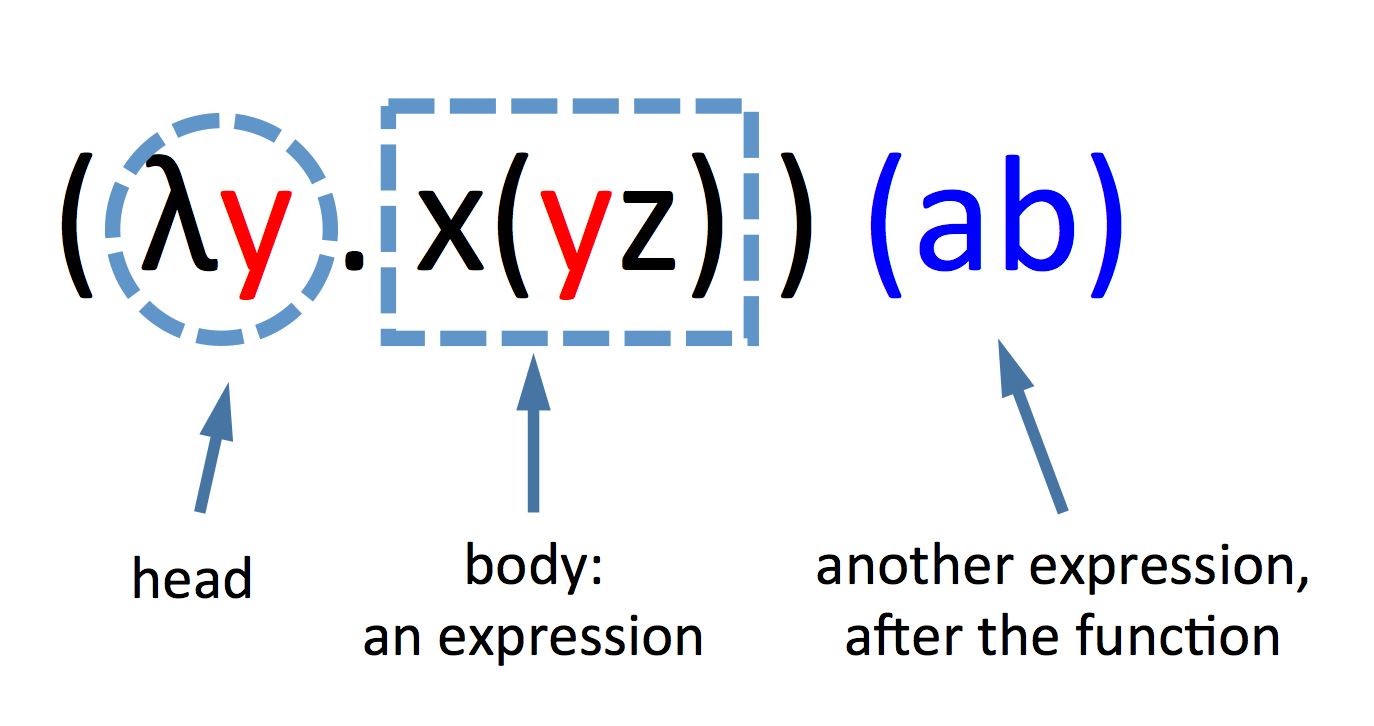
Lambda Calculus
a formal basis for functional programming
smallest universal turing complete programming language