
Consider the following testcase:
<!DOCTYPE HTML>
<style>
body { font-size: 32pt; margin:0; }
</style>

<div style="color:blue">
<div style="position:absolute; top:calc(100% - 20px); border:1px solid">Hello</div>
  <div style="break-after:always">1</div>
  <div style="">2</div>
</div>
In Print Preview you would get something like:
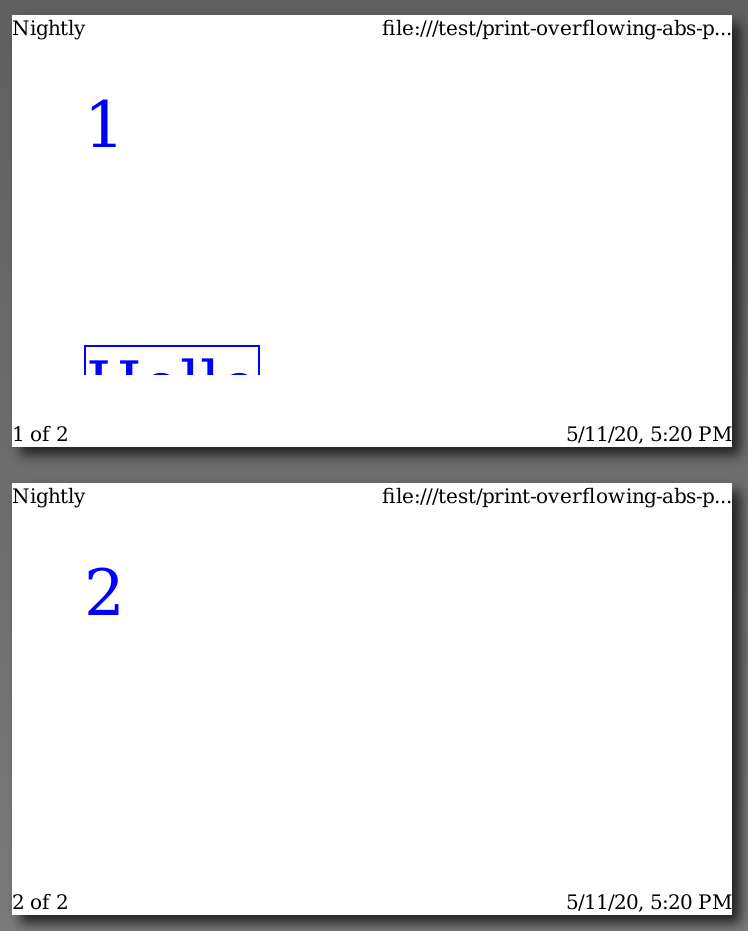
because of bug 267029.
I have an idea of how to fix bugs like this where we don't fragment a frame for some reason and it instead overflows the page content area and we clip it with "dataloss". This can be fixed in a general way by building a DisplayList for the frames on the first page with a clip area that corresponds to the second page (i.e. that starts exactly at the end edge of the first page and has the size of the second page) and include that in the DisplayList for the second page. Then you get the desired result:
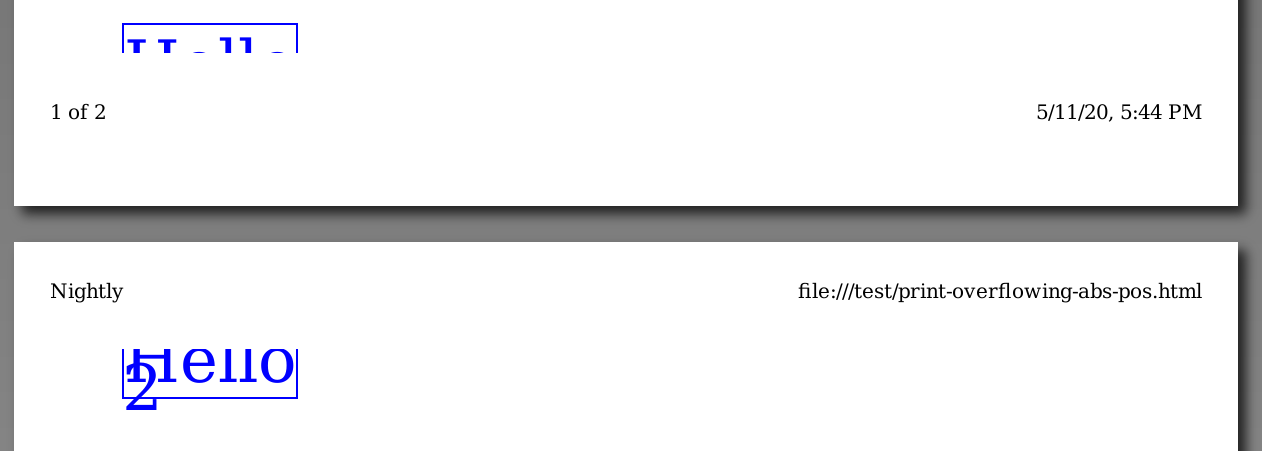
I hacked up a proof-of-concept for the above using the same technique as we use here: https://searchfox.org/mozilla-central/rev/446160560bf32ebf4cb7c4e25d7386ee22667255/layout/generic/nsPageFrame.cpp#515-543
My DisplayList-fu is weak though, so I'm hoping that someone on the Web Painting team can investigate this idea further...

A variation on the Layout side would be to create continuations for all frames, even for "atomic" ones, if they overflow. The continuation would never have any children... instead we modify BuildDisplayList* so that they generate a clipped DL from its first-in-flow (or at least its first-in-flow's children) in a similar way as I suggested for the PageContentFrame above. This is a bit trickier and more work, but it has the advantage that we can fix the "reserve space" problem easily. This variation would still require support for multiple DL for the same frame on the Paint side though.
For the record, the "reserve space" problem is that the "overflow DL" of page 1 might paint on top of content on page 2, e.g. if we clip a line box then the line after it (in the next-in-flow) will start at the top of the next page - we should reserve some space there for the overflowed part of the clipped line.
(We could do this variation as a version 2 solution though, and do the whole page as suggested above as version 1 since that's faster to implement.)