
Created
December 25, 2018 09:41
-
-
Save changhengliou/878cdab1e0ad7af7da46a9727e934438 to your computer and use it in GitHub Desktop.
Bellman ford's shortest path algorithm for finding shortest path
This file contains hidden or bidirectional Unicode text that may be interpreted or compiled differently than what appears below. To review, open the file in an editor that reveals hidden Unicode characters.
Learn more about bidirectional Unicode characters
| #include <vector> | |
| #include <queue> | |
| #include <iostream> | |
| #include <stdexcept> | |
| using namespace std; | |
| // bellman ford's algorithm is an algorithm that finds shortest path | |
| // unlike dijkstra's algorithm, it also works while the cost is negative. | |
| // the time complexity is O(V·E) | |
| // it works as follows, | |
| // iterate through every node, and examine their outward edges, | |
| // if the cost + cost[begin] is less than the curr cost of the vertex | |
| // then update that vertex. Finally we iterate at most NUM_OF_VERTICES - 1 times. | |
| // Here is a great explaination video. | |
| // https://www.youtube.com/watch?v=obWXjtg0L64&vl=en | |
| vector<int> bellmanford(vector<vector<pair<int, int>>>& graph) { | |
| vector<int> dp(graph.size(), INT_MAX); | |
| dp[0] = 0; | |
| for (int i = 0; i < graph.size() - 1; i++) { | |
| for (int curr = 0; curr < graph.size(); curr++) { | |
| if (dp[curr] == INT_MAX) continue; | |
| for (auto pair : graph[curr]) { | |
| const int dest = pair.first; | |
| const int cost = pair.second; | |
| dp[dest] = min(dp[dest], cost + dp[curr]); | |
| } | |
| } | |
| } | |
| return dp; | |
| } | |
| // optimized version with shortest route recording | |
| // since the outer for loop needs at most VERTICES - 1 times, | |
| // if one iteration through every vertex doesn't update anything | |
| // we don't have to iterate VERTICES - 1 times, but end up earlier. | |
| pair<vector<int>, vector<int>> bellmanford_opt(vector<vector<pair<int, int>>>& graph) { | |
| vector<int> dp(graph.size(), INT_MAX); | |
| vector<int> predecessor(graph.size(), -1); | |
| dp[0] = 0; | |
| for (int i = 0; i < graph.size(); i++) { | |
| bool hasChanged = false; | |
| for (int curr = 0; curr < graph.size(); curr++) { | |
| if (dp[curr] == INT_MAX) continue; | |
| for (auto pair : graph[curr]) { | |
| const int dest = pair.first; | |
| const int cost = pair.second; | |
| const int newCost = cost + dp[curr]; | |
| if (newCost < dp[dest]) { | |
| // since NUM_OF_VERTICES - 1 loops guarantees the shortest path, | |
| // if we run one more times and the dp table still updatable, | |
| // a negative cycle is detected. | |
| if (i == graph.size() - 1) throw logic_error("Negative cycle detected."); | |
| dp[dest] = newCost; | |
| predecessor[dest] = curr; | |
| hasChanged = true; | |
| } | |
| } | |
| } | |
| if (!hasChanged) break; | |
| } | |
| return { dp, predecessor }; | |
| } | |
| int main() { | |
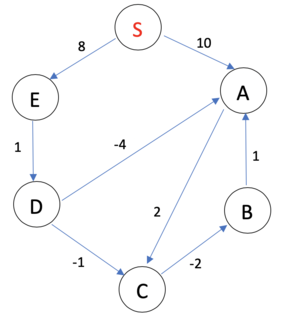
| // s: 0, a: 1, b: 2, c: 3, d: 4, e: 5 | |
| // pair.first => destination | |
| // pair.second => cost | |
| vector<vector<pair<int, int>>> graph{ | |
| { {1, 10}, {5, 8} }, | |
| { {3, 2} }, | |
| { {1, 1} }, | |
| { {2, -2} }, | |
| { {3, -1}, {1, -4} }, | |
| { {4, 1} } | |
| }; | |
| // un-comment this to try the negative cycle detection | |
| // vector<vector<pair<int, int>>> neg_graph{ | |
| // { {1, 5}, {2, 4} }, | |
| // { {3, 3} }, | |
| // { {1, -6} }, | |
| // { {2, 2} } | |
| // }; | |
| auto ans = bellmanford_opt(graph); | |
| cout << "cost = "; | |
| for (auto i : ans.first) | |
| cout << i << " "; | |
| cout << endl; | |
| int dest = 3; | |
| deque<int> path; | |
| while (dest != -1) { | |
| path.push_front(dest); | |
| dest = ans.second[dest]; | |
| } | |
| cout << "path = "; | |
| for (auto i : path) | |
| cout << i << " "; | |
| cout << endl; | |
| } |

Author
Sign up for free
to join this conversation on GitHub.
Already have an account?
Sign in to comment
Normal graph used in the code.
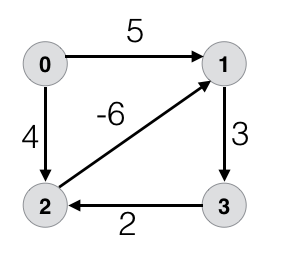
Negative cycle graph in the code, this is actually taken from here.