
Last active
February 13, 2018 16:55
-
-
Save jotterbach/373424789263b4f230c4fcf4da252b17 to your computer and use it in GitHub Desktop.
Evolution Strategy Optimizer
This file contains hidden or bidirectional Unicode text that may be interpreted or compiled differently than what appears below. To review, open the file in an editor that reveals hidden Unicode characters.
Learn more about bidirectional Unicode characters
| (* | |
| The Evolution Strategy Optimizer is a Hill-Climbing routine based on stochastic gradient | |
| estimation (not to be confused with stochastic gradient descent optimization). The basic idea | |
| is to perturb the current best parameter value using Gaussian noise and explore the function | |
| values of the blackbox objective in the vicinity of the parameters. From these explorations one | |
| can estimate the gradient and perform a gradient update step. | |
| More information can be found in: | |
| - T. Salimans et al. Evolution Strategies as a Scalable Alternative to Reinforcement Learning, | |
| arXiv:1703.03864, https://arxiv.org/pdf/1703.03864.pdf | |
| - D. Wierstra et al. Natural Evolution Strategies, JMLR 15 (2014) 949-980, | |
| http://www.jmlr.org/papers/volume15/wierstra14a/wierstra14a.pdf | |
| *) | |
| open Owl | |
| open Core | |
| let rosenbrock ~param:p ~inp:x = | |
| -1. *. ((p.(0) -. x.(0))**2. +. p.(1) *. (x.(1) -. x.(0)**2.)**2.) | |
| let es_grad ~batch_size:bs ~f:f ~inp:(inp : float array) ~scale:scale = | |
| let dim = Array.length inp in | |
| let center = Mat.of_array inp 1 dim in | |
| let all_perts = Mat.gaussian bs dim in | |
| let displaced_perts = Mat.(center + (scale $* all_perts)) in | |
| let all_func_vals = Mat.map_rows (fun m -> f ~inp:(m |> Mat.to_array)) displaced_perts in | |
| let mu = Stats.mean all_func_vals in | |
| let sigma = Stats.std all_func_vals in | |
| let norm_func_vec = Mat.( ((of_array all_func_vals bs 1) -$ mu) /$ sigma ) in | |
| Mat.(norm_func_vec * all_perts) |> Mat.fold ~axis:0 (+.) 0. | |
| let update_params lr bs scale f params = | |
| let par_vec = Mat.of_array (Array.copy params) 1 (Array.length params) in | |
| let grad = es_grad ~batch_size:bs ~f:f ~inp:params ~scale:scale in | |
| let alpha = lr /. (scale *. (bs |> float_of_int)) in | |
| Mat.(par_vec + (alpha $* grad)) |> Mat.to_array | |
| let optimize ~lr:lr ~bs:bs ~scale:scale ~f:f ~x0:x0 ~epochs:epochs = | |
| let vals = ref [|f ~inp:x0|] in | |
| let params = ref [|(Array.copy x0)|] in | |
| let p = ref (Array.copy x0) in | |
| let n_step = ref 0 in | |
| while !n_step <= epochs do | |
| incr n_step; | |
| p := (update_params lr bs scale f !p); | |
| params := Array.append !params [|!p|]; | |
| vals := Array.append !vals [|(f ~inp:!p)|]; | |
| done; | |
| (!vals, !params) | |
| let br_rosenbrock x y = | |
| let xm1 = Mat.(x -$ 1.) in | |
| let add0 = Mat.(xm1 * xm1) in | |
| let fac1 = Mat.(y - x * x) in | |
| let add1 = Mat.( 100. $* (fac1 * fac1) ) in | |
| Mat.(add0 + add1) | |
| let plot_opt ~trace:tr ~loc:loc = | |
| let x, y = Mat.meshgrid (-2.) 2. (-0.5) 2. 200 200 in | |
| let z = br_rosenbrock x y |> Mat.clip_by_value ~amin:0. ~amax:5. in | |
| let h = Plot.create loc in | |
| Plot.(contour ~h x y z); | |
| Plot.(scatter ~h ~spec:[ RGB (255,255,0); Marker "#[0x2666]"; MarkerSize 5. ] (Mat.col tr 0) (Mat.col tr 1)); | |
| Plot.output h | |
| let run_example () = | |
| let f = rosenbrock ~param:[|1.;100.|] in | |
| let (vals, params) = optimize ~f:f ~x0:[|-0.23; 1.06|] ~epochs:5000 ~lr:0.00001 ~bs:100 ~scale:0.0001 in | |
| let loc = "rosenbrock.png" in | |
| let tr = Mat.of_arrays params in | |
| plot_opt ~loc:loc ~trace:tr |

Author
Sign up for free
to join this conversation on GitHub.
Already have an account?
Sign in to comment
The output will create a plot similar to the one below
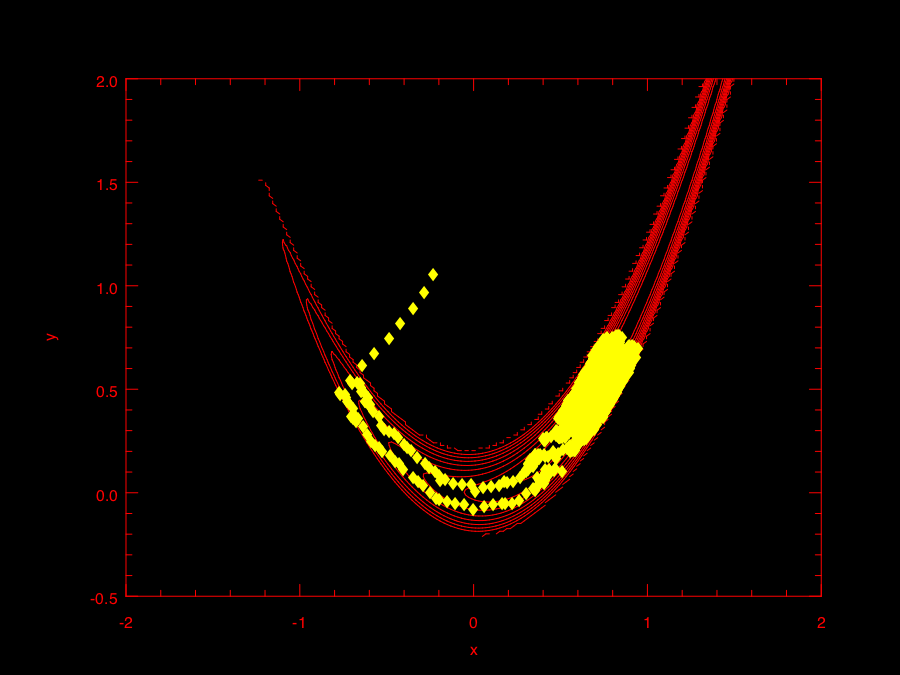
The Rosenbrock function is one of the typical functions used to evaluate optimizers