(defprofile lagénorhynque
  :id           @lagenorhynque
  :reading      "/laʒenɔʁɛ̃k/"
  :aliases      ["カマイルカ🐬"]

  :languages    [Clojure Haskell English français]

  :interests    [programming language-learning law mathematics]

  :commits      ["github.com/lagenorhynque/duct.module.pedestal"]

  :contributes  ["github.com/japan-clojurians/clojure-site-ja"])

Clojure編: データ指向なREST API開発について
cf. BOOTH https://booth.pm/ja/items/1317263
-
ClojureとElixir
-
私のElixir入門
-
Clojureとよく似ているところ
-
Clojureと大きく違うところ
-
作者: Rich Hickey
-
登場時期: 2007年
-
最新安定版: 1.10.0
-
主な特徴:
- Java VM (JVM)で動作する
- Lisp の伝統を継承/克服している
- 並行プログラミング を強力に支援する
- 動的型付けの 関数型言語
-
作者: José Valim
-
登場時期: 2011年
-
最新安定版: 1.8.2
-
主な特徴:
- Erlang VM (EVM; BEAM)で動作する
- Ruby に似たシンタックス
- Clojure の影響が見られる
- 動的型付けの 関数型言語
;; REPL (read-eval-print loop)

user> (->> (iterate (fn [[a b]] [b (+ a b)]) [0 1])
           (map first)
           (take 20))
(0 1 1 2 3 5 8 13 21 34 55 89 144 233 377 610 987 1597 2584 4181)# IEx (Interactive Elixir)
iex(1)> Stream.iterate({0, 1}, fn {a, b} -> {b, a+b} end) |>
...(1)> Stream.map(&elem(&1, 0)) |>
...(1)> Enum.take(20)
[0, 1, 1, 2, 3, 5, 8, 13, 21, 34, 55, 89, 144, 233, 377, 610,
987, 1597, 2584, 4181]
# または
iex(2)> Stream.unfold({0, 1}, fn {a, b} -> {a, {b, a+b}} end) |>
...(2)> Enum.take(20)
[0, 1, 1, 2, 3, 5, 8, 13, 21, 34, 55, 89, 144, 233, 377, 610,
987, 1597, 2584, 4181]à la Clojure?
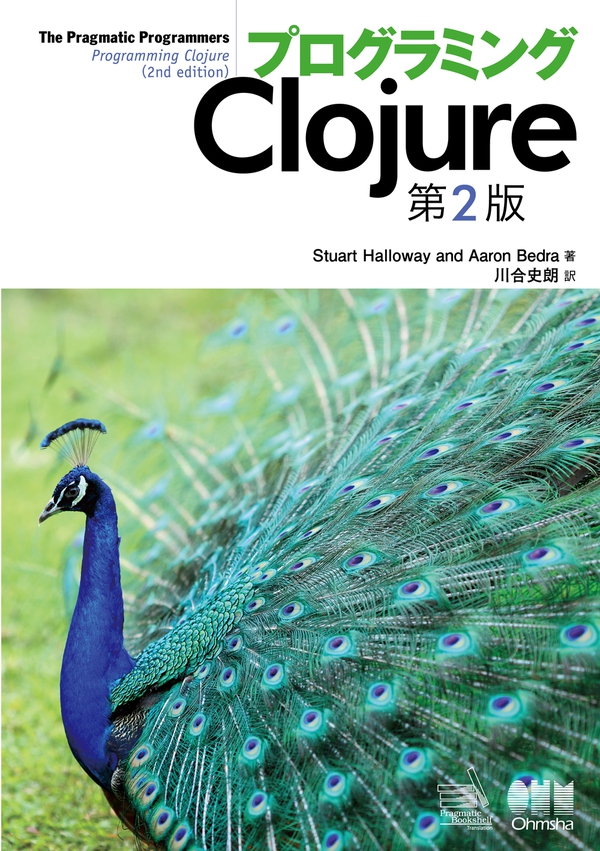
cf. 最新版: Programming Clojure, Third Edition

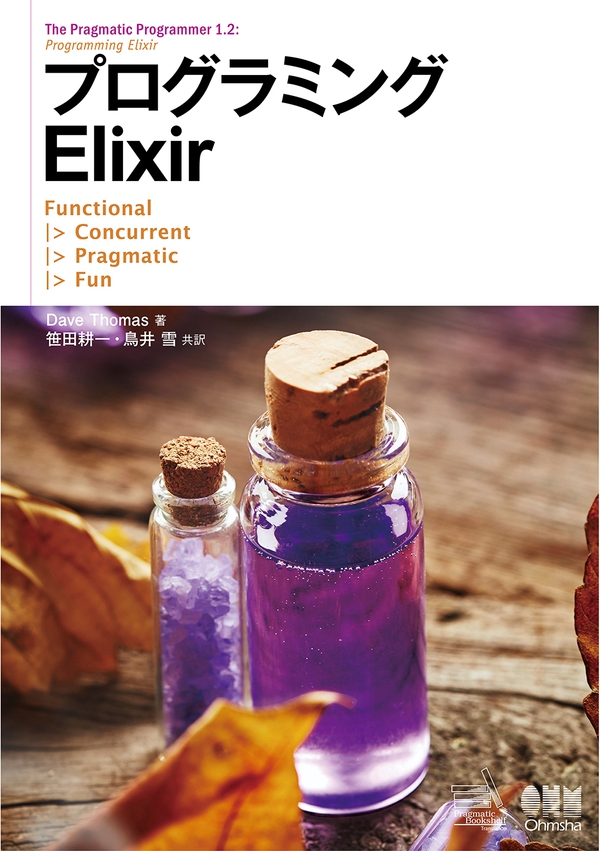
cf. 最新版: Programming Elixir ≥ 1.6

- Ruby, Io, Prolog, Scala, Erlang, Clojure, Haskell

- Lua, Factor, Elixir, Elm, Julia, MiniKanren, Idris

- Chapter 3, 4, 6: Clojure
- Chapter 5: Elixir



Elixir公式ドキュメント Getting Started


-
基本的なプログラミングスタイル
-
プロトコルによるポリモーフィズム
-
マクロによるメタプログラミング
user> '(1 2 3)          ; リスト ※クォートにより、要素は評価されない
(1 2 3)
user> [1 2 3]           ; ベクター
[1 2 3]
user> {:a 1 :b 2 :c 3}  ; マップ
{:a 1, :b 2, :c 3}iex(2)> [1, 2, 3] # リスト
[1, 2, 3]
iex(3)> {1, 2, 3} # タプル
{1, 2, 3}
iex(4)> %{a: 1, b: 2, c: 3} # マップ
%{a: 1, b: 2, c: 3}cf. 括弧の使い分け、カンマ (Clojureでは 空白 扱い)
user> (ns example)         ; 名前空間 `example`
nil
example> (defn square [x]  ; 関数 `square`
           (* x x))
#'example/square
example> (in-ns 'user)     ; デフォルトの名前空間 `user` に戻る
#namespace[user]
user>iex(5)> defmodule Example do # モジュール `Example`
...(5)> def square(x) do # 関数 `square`
...(5)> x * x
...(5)> end
...(5)> end
{:module, Example,
<<70, 79, 82, 49, 0, 0, 4, 100, 66, 69, 65, 77, 65, 116, 85, 56, 0, 0, 0, 130,
0, 0, 0, 14, 14, 69, 108, 105, 120, 105, 114, 46, 69, 120, 97, 109, 112, 108,
101, 8, 95, 95, 105, 110, 102, 111, 95, ...>>, {:square, 1}}user> (example/square 3) ; `example` の `square` 関数を適用
9
user> (map example/square (range 1 (inc 10)))
(1 4 9 16 25 36 49 64 81 100)iex(6)> Example.square(3) # `Example` の `square` 関数を適用
9
iex(7)> Enum.map(1..10, &Example.square/1)
[1, 4, 9, 16, 25, 36, 49, 64, 81, 100]user> (map (fn [x] (* x x)) (range 1 (inc 10)))
(1 4 9 16 25 36 49 64 81 100)
user> (map #(* % %) (range 1 (inc 10)))
(1 4 9 16 25 36 49 64 81 100)iex(8)> Enum.map(1..10, fn(x) -> x * x end)
[1, 4, 9, 16, 25, 36, 49, 64, 81, 100]
iex(8)> Enum.map(1..10, &(&1 * &1))
[1, 4, 9, 16, 25, 36, 49, 64, 81, 100]user> (->> (range 1 (inc 10))
(map #(* % %))
(filter odd?)
(apply +))
165iex(9)> require Integer
Integer
iex(10)> 1..10 |>
...(10)> Enum.map(&(&1 * &1)) |>
...(10)> Enum.filter(&Integer.is_odd/1) |>
...(10)> Enum.sum
165cf. 関数の引数の順序
user> (defprotocol Shape  ; プロトコル `Shape`
        (area [x]))       ; プロトコルのメソッド `area`
Shapeiex(1)> defprotocol Shape do # プロトコル `Shape`
...(1)> def area(x) # プロトコルのメソッド `area`
...(1)> end
{:module, Shape, ..., {:__protocol__, 1}}
user> (defrecord Triangle [x h]  ; レコード `Triangle`
        Shape                    ; プロトコル実装
        (area [{:keys [x h]}] (/ (* x h) 2)))
user.Triangle
user> (area (map->Triangle {:x 3 :h 2}))
3
user> (defrecord Rectangle [x y] ; レコード `Rectangle`
Shape ; プロトコル実装
(area [{:keys [x y]}] (* x y)))
user.Rectangle
user> (area (map->Rectangle {:x 2 :y 3}))
6iex(2)> defmodule Triangle do # 構造体 `Triangle`
...(2)> defstruct [:x, :h]
...(2)> end
{:module, Triangle, ..., %Triangle{h: nil, x: nil}}
iex(3)> defimpl Shape, for: Triangle do # プロトコル実装
...(3)> def area(%Triangle{x: x, h: h}), do: x * h / 2
...(3)> end
{:module, Shape.Triangle, ..., {:__impl__, 1}}
iex(4)> Shape.area(%Triangle{x: 3, h: 2})
3.0iex(5)> defmodule Rectangle do # 構造体 `Rectangle`
...(5)> defstruct [:x, :y]
...(5)> end
{:module, Rectangle, ..., %Rectangle{x: nil, y: nil}}
iex(6)> defimpl Shape, for: Rectangle do # プロトコル実装
...(6)> def area(%Rectangle{x: x, y: y}), do: x * y
...(6)> end
{:module, Shape.Rectangle, ..., {:__impl__, 1}}
iex(7)> Shape.area(%Rectangle{x: 2, y: 3})
6user> (defrecord Circle [r]) ; レコード `Circle`
user.Circle
user> (area (map->Circle {:r 3}))
Execution error (IllegalArgumentException) at user/eval5412$fn$G
(REPL:47).
No implementation of method: :area of protocol: #'user/Shape fou
nd for class: user.Circleiex(8)> defmodule Circle do # 構造体 `Circle`
...(8)> defstruct [:r]
...(8)> end
{:module, Circle, ..., %Circle{r: nil}}
iex(9)> Shape.area(%Circle{r: 3})
** (Protocol.UndefinedError) protocol Shape not implemented for
%Circle{r: 3}
iex:2: Shape.impl_for!/1
iex:3: Shape.area/1
user> (extend-protocol Shape  ; プロトコル実装
        Circle
        (area [{:keys [r]}] (* Math/PI r r)))
nil
user> (area (map->Circle {:r 3}))
28.274333882308138iex(10)> defimpl Shape, for: Circle do # プロトコル実装
...(10)> def area(%Circle{r: r}), do: :math.pi() * r * r
...(10)> end
{:module, Shape.Circle, ..., {:__impl__, 1}}
iex(11)> Shape.area(%Circle{r: 3})
28.274333882308138
user> '(when (= 1 1)
         (println "Truthy!"))
(when (= 1 1) (println "Truthy!"))
;; または
user> (quote
       (when (= 1 1)
         (println "Truthy!")))
(when (= 1 1) (println "Truthy!"))iex(1)> quote do
...(1)> if 1 == 1 do
...(1)> IO.puts "Truthy!"
...(1)> end
...(1)> end
{:if, [context: Elixir, import: Kernel],
[
{:==, [context: Elixir, import: Kernel], [1, 1]},
[
do: {{:., [], [{:__aliases__, [alias: false], [:IO]}, :puts
]}, [],
["Truthy!"]}
]
]}user> (ns example)
nil
example> (defmacro my-when-not [test & body]
`(if ~test
nil
(do ~@body)))
#'example/my-when-not
example> (in-ns 'user)
#namespace[user]
user>iex(2)> defmodule Example do
...(2)> defmacro my_unless(test, do: body) do
...(2)> quote do
...(2)> if unquote(test), do: nil, else: unquote(body)
...(2)> end
...(2)> end
...(2)> end
{:module, Example, ..., {:my_unless, 2}}user> (example/my-when-not (= 1 2)
(println "Falsy!")
42)
Falsy!
42
user> (example/my-when-not (= 1 1)
(println "Falsy!")
42)
niliex(3)> require Example
Example
iex(4)> Example.my_unless 1 == 2 do
...(4)> IO.puts "Falsy!"
...(4)> 42
...(4)> end
Falsy!
42
iex(5)> Example.my_unless 1 == 1 do
...(5)> IO.puts "Falsy!"
...(5)> 42
...(5)> end
niluser> (macroexpand-1 ; マクロを1段階展開
'(example/my-when-not (= 1 2)
(println "Falsy!")
42))
(if (= 1 2) nil (do (println "Falsy!") 42))iex(6)> quote do
...(6)> Example.my_unless 1 == 2 do
...(6)> IO.puts "Falsy!"
...(6)> 42
...(6)> end
...(6)> end |> Macro.expand_once(__ENV__) |> # マクロを1段階展開
...(6)> Macro.to_string |> IO.puts # ASTを文字列表現に
if(1 == 2) do
nil
else
IO.puts("Falsy!")
42
end
:ok-
分配束縛 vs パターンマッチング
- cf. Simple Made Easy (by Rich Hickey)
-
並行プログラミングに対するアプローチ
-
開発環境としてのREPLの位置付け
- cf. REPL駆動開発 (REPL-driven development)