
When baking a texture in Blender (or other 3D editing software) and using it in ThreeJS as a MeshBasicMaterial - it will not interact with any lighting in your scene. If you try to use a material that will (EG MeshStandardMaterial) you'll find that your baked textures don't look right - because they're being lit both during the baking and the real-time-rendering.
Using this material will allow you to have specular reflections (EG glossy or shiny textures) while still maintaining baked lighting. Here's an example of what I'm talking about:
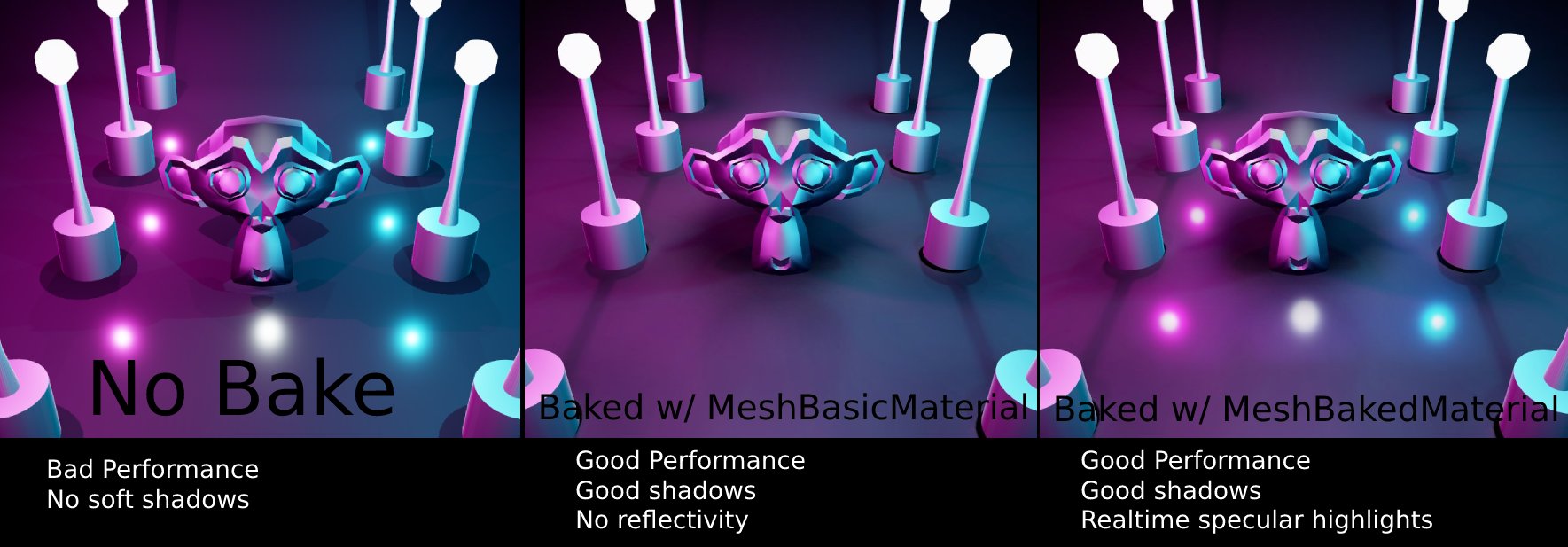
Here's the code that enables this. Simply copy-and-paste it into your project. Remove the typescript typings if you're on vanilla JS.
import * as THREE from 'three';

const before = `totalDiffuse + totalSpecular + totalEmissiveRadiance`;
const after = `sampledDiffuseColor.rgb + reflectedLight.indirectDiffuse + reflectedLight.directSpecular + reflectedLight.indirectSpecular + totalEmissiveRadiance`

export class MeshBakedMaterial extends THREE.MeshStandardMaterial {
  constructor(parameters?: THREE.MeshStandardMaterialParameters) {
    super(parameters);

    this.onBeforeCompile = (shader) => {
      shader.fragmentShader = shader.fragmentShader.replace(before, after)
    };
  }
}
With this approach you can continue to use roughness/metalness values or maps, and get dramatic results, while still saving on performance by baking nice shadows. Use like so:
const mat = new MeshBakedMaterial({map: bakedMap, roughness: 0.1, metalness: 0.3});
Shout out to Bruno Simon and his ThreeJS Journey class, without which I'd be completely lost.