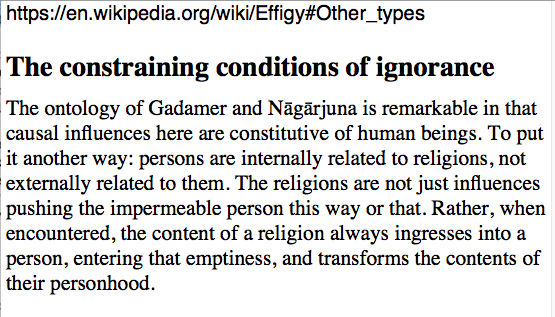
the constraining conditions of Ignorance
hermeneutic cycles
alterity, transitive closure ("recognition"); exchanging perspectives and prejudices
money and debt: intentionality "of the same hermeneutic coupling"
The acquisition and control of knowledge as a means of productior has been richly rewarded with money, status, and influence in modern industrial societies, and thinking as a pure activity, uncontaminated by acquisitive desires, has every- where had a relatively difficult time. Therefore — that is, because knowledge was highly privileged and thinking not so privileged — what gradually took shape in modern industrial societies were social classes which distinguished themselves by virtue of their control of certain forms of knowledge.
— Robert R. Sullivan, Political Hermeneutics: Early Thinking of Hans-Georg Gadamer
the formation of subjectivity: the cryptophilology and intersubjectivity of Loss and Lend
See: Gadamerian and Ricoeurian hermeneutics and its application to interpretive accounting research
[...] the form "das Erlebte" is used to mean the permanent content of what is experienced. This content is like a yield or result that achieves permanence, weight, and significance from out of the transience of experiencing. Both meanings obviously lie behind the coinage Erlebnis: both the immediacy, which precedes all interpretation, reworking, and communication, and merely offers a starting point for interpretation—material to be shaped—and its discovered yield, its lasting result [1]
textual interpretation, cycles of reflexivity; closure instigated by reckoning
money as subject back-formation
economic hermeneutics is the cyclic nature of tokenship