
Last active
October 27, 2020 15:32
-
-
Save ravachol70/a730b96dbda30cd573e34d393d8c8d52 to your computer and use it in GitHub Desktop.
Chrematistics in Marketing
This file contains hidden or bidirectional Unicode text that may be interpreted or compiled differently than what appears below. To review, open the file in an editor that reveals hidden Unicode characters.
Learn more about bidirectional Unicode characters
| a desire for universal recognition | |
| >Kojève’s stressing of the chapter on Lord and Bondsman in Hegel’s Phenomenology of Spirit. This duality formed around the question of desire, mutual recognition, and intersubjectivity through negation, and is inarguably Kojève’s most enduring legacy in twentieth and twenty-first century thought, so definitively sculpting the discourse around identity and difference that for someone like Lacan, “every reference to ‘Hegel’ should be glossed ‘Kojève’” | |
| Kojèvian desire | |
| desire and social alterity | |
| money and debt: interrelational | |
| desire’s role in the formation of subjectivity | |
| >Man who desires a thing like a human acts not so much in order to take possession of the thing as to make his right recognized by another […] over this thing, to make himself recognized as owner of the thing. | |
| action guided by lack | |
| money as subject formation |

Author
Author
Author
Author
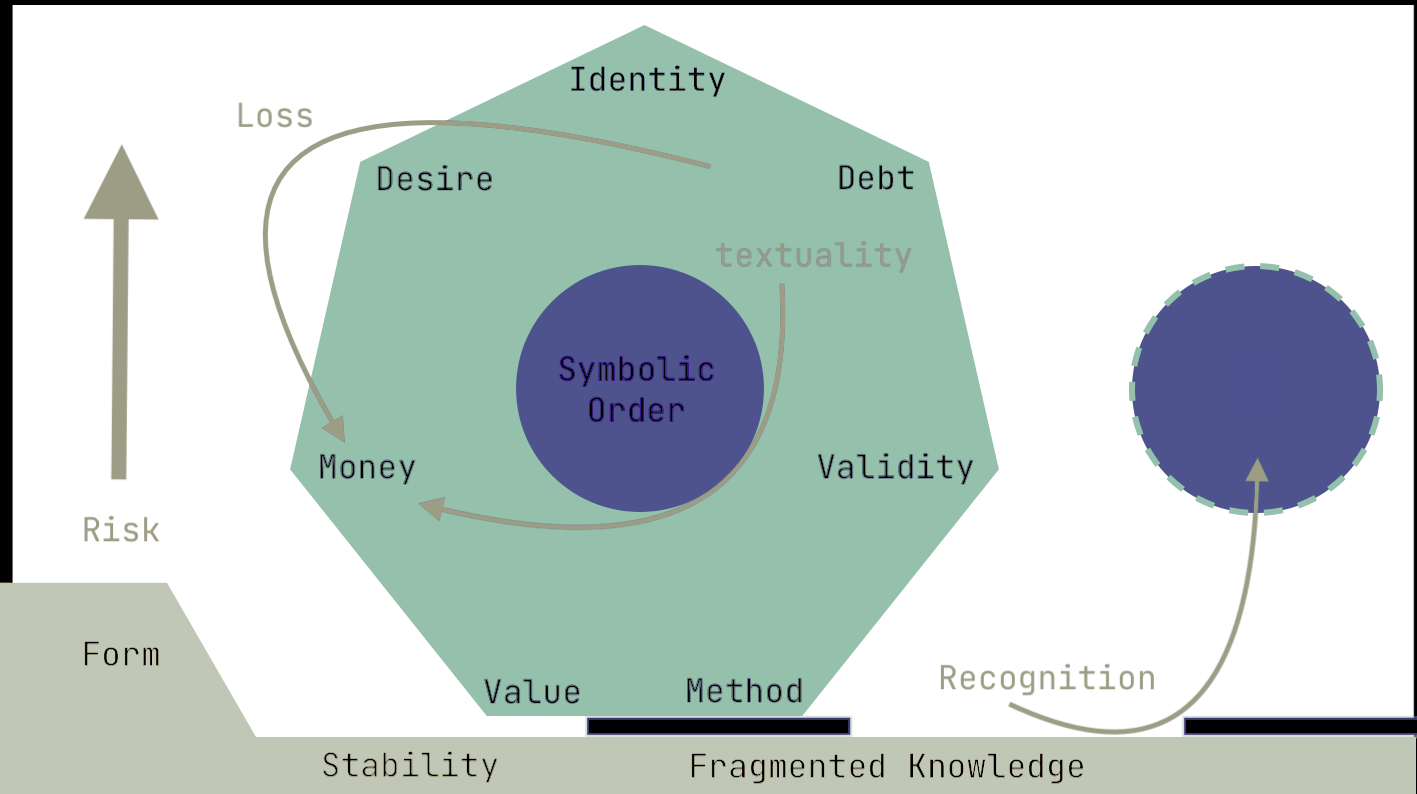
Desire Risk Form
Sign up for free
to join this conversation on GitHub.
Already have an account?
Sign in to comment
Kojève’s stressing of the chapter on Lord and Bondsman in Hegel’s Phenomenology of Spirit. This duality formed around the question of desire, mutual recognition, and intersubjectivity through negation, and is inarguably Kojève’s most enduring legacy in twentieth and twenty-first century thought, so definitively sculpting the discourse around identity and difference that for someone like Lacan, “every reference to ‘Hegel’ should be glossed ‘Kojève’”
http://d-scholarship.pitt.edu/37960/13/Wilson_Trevor_Dissertation_ETD.pdf
Man who desires a thing like a human acts not so much in order to take possession of the thing as to make his right recognized by another […] over this thing, to make himself recognized as owner of the thing.
—A. Kojève, Esquisse d’une phénoménologie du droit