
Created
June 14, 2017 10:55
-
-
Save tsu-nera/253bed4f207a08d9564851a52aab00a6 to your computer and use it in GitHub Desktop.
モンテカルロ法でtic-tac-toe
This file contains hidden or bidirectional Unicode text that may be interpreted or compiled differently than what appears below. To review, open the file in an editor that reveals hidden Unicode characters.
Learn more about bidirectional Unicode characters
| import gym | |
| import numpy as np | |
| import gym_tic_tac_toe | |
| import random | |
| from math import floor | |
| import matplotlib.pyplot as plt | |
| def random_plus_middle_move(moves, p): | |
| if ([p, 4] in moves): | |
| m = [p, 4] | |
| else: | |
| m = random_move(moves, p) | |
| return m | |
| def random_move(moves, p): | |
| m = random.choice(moves) | |
| return m | |
| env = gym.make('tic_tac_toe-v0') | |
| n_states = 3**9 | |
| n_actions = 9 | |
| rate = [] | |
| def monte_carlo_policy_iteration(L,M,options): | |
| T = 10 | |
| # initiate lookup table | |
| Q = np.zeros((n_states, n_actions)) | |
| #################### | |
| # policy iteration | |
| #################### | |
| for l in range(L): | |
| visits = np.ones((n_states, n_actions)) | |
| states = np.ones((M, T)) | |
| actions = np.ones((M, T)) | |
| rewards = np.zeros((M, T)) | |
| drewards = np.ones((M, T)) | |
| results = np.zeros(M) | |
| np.random.seed(555) | |
| # episode | |
| for m in range(M): | |
| state = env.reset() | |
| state3 = state['board'] | |
| done = False | |
| # step | |
| for t in range(T): | |
| state3 = encode1(state3) | |
| state10 = encode2(state3) | |
| # generate policy | |
| policy = np.zeros(n_actions) | |
| ##################### | |
| # policy improvement | |
| ##################### | |
| policy = policy_improvement(options, Q, state10, policy) | |
| action, state, reward, done = action_train(t, state3, policy) | |
| state3 = state['board'] | |
| states[m,t] = state10 | |
| actions[m,t] = action[1] | |
| rewards[m,t] = reward | |
| visits[state10, action[1]] += 1 | |
| if done or env.move_generator() == []: | |
| if reward == 1: | |
| fin = 2 | |
| elif reward == -1: | |
| fin = 1 | |
| elif reward == 0: | |
| fin = 3 | |
| else: | |
| fin = None | |
| results[m] = fin | |
| drewards = calculate_discounted_rewards(m, t, rewards, | |
| options, drewards) | |
| break | |
| ##################### | |
| # policy evaluation | |
| ##################### | |
| Q = policy_evaluation(M, T, states, actions, drewards, visits) | |
| output_results(l, results, M) | |
| rate.append( float(len(results[results==2]))/M ) | |
| ############################################################################### | |
| ############################################################################### | |
| convert = [[0,1,2,3,4,5,6,7,8], | |
| [2,1,0,5,4,3,8,7,6], | |
| [6,3,0,7,4,1,8,5,2], | |
| [0,3,8,1,4,7,2,5,8], | |
| [8,7,6,5,4,3,2,1,0], | |
| [6,7,8,3,4,5,0,1,2], | |
| [2,5,8,1,4,7,0,3,6], | |
| [8,5,2,7,4,1,6,3,0] | |
| ] | |
| power = np.array([ 3**i for i in range(8,-1,-1) ], dtype=np.float64) | |
| def encode1(state3): | |
| ret = np.empty(len(state3)) | |
| for n, i in enumerate(state3): | |
| if i == -1: | |
| ret[n] = 1 | |
| elif i == 1: | |
| ret[n] = 2 | |
| else: | |
| ret[n] = 0 | |
| return ret | |
| def encode2(state3): | |
| cands = [sum(state3[convert[i]]*power) for i in range(len(convert))] | |
| return int(min(cands))+1 | |
| def policy_improvement(options, Q, state10, policy): | |
| if options['pmode']==0: | |
| q = Q[state10] | |
| v = max(q) | |
| a = np.where(q==v)[0][0] | |
| policy[a] = 1 | |
| elif options['pmode']==1: | |
| q = Q[state10] | |
| v = max(q) | |
| a = np.where(q==v)[0][0] | |
| policy = np.ones(n_actions)*options['epsilon']/n_actions | |
| policy[a] = 1-options['epsilon']+options['epsilon']/n_actions | |
| elif options['pmode']==2: | |
| policy = np.exp(Q[state10]/options['tau'])/ \ | |
| sum(np.exp(Q[state10]/options['tau'])) | |
| return policy | |
| def select_npc_action(step, state3, policy): | |
| a = None | |
| # first step is always select 0 | |
| if step==0: | |
| return [1, 0] | |
| else: | |
| while 1: | |
| random = np.random.rand() | |
| cprob = 0 | |
| for a in range(n_actions): | |
| cprob += policy[a] | |
| if random<cprob: | |
| break | |
| if state3[a]==0: | |
| break | |
| return [1, a] | |
| def select_enemy_action(state3, moves): | |
| reach = False | |
| pos = [[0,1,2],[3,4,5],[6,7,8],[0,3,6],[1,4,7],[1,5,8],[0,4,8],[2,4,6]] | |
| a = None | |
| for i in range(len(pos)): | |
| state_i = state3[pos[i]] | |
| val = sum(state_i) | |
| num = len(state_i[state_i==0]) | |
| if val==2 and num==1: | |
| idx = int( state_i[state_i==0][0] ) | |
| a = pos[i][idx] | |
| if [-1, a] in moves: | |
| reach = True | |
| break | |
| if not reach: | |
| while 1: | |
| a = floor(np.random.rand()*8)+1 | |
| if state3[a] == 0: | |
| break | |
| return [-1, a] | |
| def action_train(t, state3, policy): | |
| # select action | |
| npc_action = select_npc_action(t, state3, policy) | |
| # action execute | |
| state, reward, done, _ = env.step(npc_action) | |
| moves = env.move_generator() | |
| if done or moves == []: | |
| return npc_action, state, reward, done | |
| state3 = encode1(state['board']) | |
| enemy_action = select_enemy_action(state3, moves) | |
| # action execute | |
| state, reward, done, _ = env.step(enemy_action) | |
| if not done and reward == 0: | |
| reward = None | |
| return npc_action, state, reward, done | |
| def calculate_discounted_rewards(m, t, rewards, options, drewards): | |
| drewards[m,t] = rewards[m,t] | |
| for pstep in range(t-1,-1, -1): | |
| drewards[m,pstep] = options['gamma']*drewards[m,pstep+1] | |
| return drewards | |
| def output_results(l, results, M): | |
| print('l=%d: Win=%d/%d, Draw=%d/%d, Lose=%d/%d' % (l, \ | |
| len(results[results==2]),M, \ | |
| len(results[results==3]),M, \ | |
| len(results[results==1]),M)) | |
| def policy_evaluation(M, T, states, actions, drewards, visits): | |
| Q = np.zeros((n_states, n_actions)) | |
| for m in range(M): | |
| for t in range(T): | |
| s = states[m,t] | |
| a = actions[m,t] | |
| s = int(s) | |
| a = int(a) | |
| Q[s,a] += drewards[m,t] | |
| return Q/visits | |
| if __name__=='__main__': | |
| options = {'pmode':1 ,'epsilon':0.05,'tau':2,'gamma':0.9} | |
| monte_carlo_policy_iteration(10,1000,options) | |
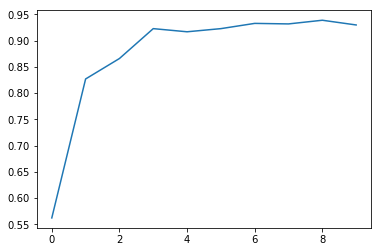
| plt.plot(range(len(rate)), rate) | |
| plt.show() |

tsu-nera
commented
Jun 14, 2017
Author
Sign up for free
to join this conversation on GitHub.
Already have an account?
Sign in to comment