
Last active
May 5, 2021 17:53
-
-
Save vene/83bee4552339bd184cfaec0606be529c to your computer and use it in GitHub Desktop.
Pardalos & Kovoor's O(n) solver for singly-constrained bounded QPs
This file contains hidden or bidirectional Unicode text that may be interpreted or compiled differently than what appears below. To review, open the file in an editor that reveals hidden Unicode characters.
Learn more about bidirectional Unicode characters
| # Author: Vlad Niculae <vlad@vene.ro> | |
| # License: Simplified BSD | |
| import numpy as np | |
| try: | |
| from numba import jit | |
| except ImportError: | |
| print("numba not available") | |
| def jit(nopython): | |
| def id(f): | |
| return f | |
| return id | |
| @jit(nopython=True) | |
| def solve_pardalos(c, d, a, b): | |
| """Solve the following constrained QP | |
| minimize sum_i c_i x_i^2 | |
| st sum_i c_i x_i = d | |
| a[i] <= x_i <= b[i] | |
| Parameters | |
| ---------- | |
| c, a, b: ndarrays of length n | |
| d: scalar | |
| Returns | |
| ------- | |
| x: ndarray of length n | |
| Notes | |
| ----- | |
| Naive / straightforward implementation based on: | |
| An algorithm for a singly constrained class of quadratic | |
| programs subject to upper and lower bounds. | |
| P. M. Pardalos and N. Kovoor. 1990. | |
| https://link.springer.com/article/10.1007/BF01585748 | |
| Assuming np.median() is efficient, this should be O(n) | |
| """ | |
| UnsetV = list(range(len(c))) | |
| NINF = -np.inf | |
| PINF = np.inf | |
| Intervalpts = [NINF, PINF] | |
| for i in range(len(c)): | |
| Intervalpts.append(a[i]) | |
| Intervalpts.append(b[i]) | |
| Min = NINF | |
| Max = PINF | |
| Tightsum = 0 | |
| Slackweight = 0 | |
| while len(UnsetV) > 0: | |
| Intervalpts_np = np.array(Intervalpts) | |
| Mid = np.median(Intervalpts_np) | |
| Testsum = Tightsum | |
| for i in UnsetV: | |
| if b[i] < Mid: | |
| Testsum += c[i] * b[i] | |
| if a[i] > Mid: | |
| Testsum += c[i] * a[i] | |
| tmp = 0 | |
| for i in UnsetV: | |
| if a[i] <= Mid <= b[i]: | |
| tmp += c[i] | |
| Testsum += (Slackweight + tmp) * Mid | |
| if Testsum <= d: | |
| Min = Mid | |
| if Testsum >= d: | |
| Max = Mid | |
| # below differs from original paper: strict inequalities. | |
| # I encountered infinite cycling otherwise. | |
| Intervalpts = [ppp for ppp in Intervalpts if Min < ppp < Max] | |
| for i in UnsetV: | |
| if b[i] <= Min: | |
| Tightsum += c[i] * b[i] | |
| if a[i] >= Max: | |
| Tightsum += c[i] * a[i] | |
| if a[i] <= Min and b[i] >= Max: | |
| Slackweight += c[i] | |
| UnsetV = [i for i in UnsetV if (Min < a[i] < Max) or (Min < b[i] < Max)] | |
| if Slackweight != 0 and (d - Tightsum) != 0: | |
| tau = (d - Tightsum) / Slackweight | |
| else: | |
| tau = Mid | |
| return np.maximum(a, np.minimum(b, tau)) | |
| def project_constraints(theta, z, lower=0, upper=1): | |
| """Use the Pardalos & Kovoor algorithm to compute the euclidean projection: | |
| argmin || y - theta || | |
| st sum_i y_i = z | |
| lower <= y_i <= upper | |
| Uses a simple change of variable. | |
| Parameters | |
| ---------- | |
| theta: ndarray, length n | |
| lower, upper: scalars or ndarrays of length n | |
| z: scalar | |
| Returns | |
| ------- | |
| y: ndarray, length n | |
| """ | |
| a = (lower - theta) / 2 | |
| b = (upper - theta) / 2 | |
| c = np.ones_like(theta) | |
| d = (z - np.sum(theta)) / 2 | |
| out = solve_pardalos(c, d, a, b) | |
| return 2 * out + theta | |
| if __name__ == '__main__': | |
| from time import clock | |
| try: | |
| import matplotlib.pyplot as plt | |
| plot = True | |
| except ImportError: | |
| plot = False | |
| rng = np.random.RandomState(0) | |
| # run once to initialize numba | |
| theta = rng.randn(10) | |
| project_constraints(theta, 4) | |
| n_runs = 100 | |
| n_problems = 20 | |
| ns = np.arange(1000, 10000, step=500) | |
| all_times = [[] for _ in ns] | |
| for n, times in zip(ns, all_times): | |
| z = n // 10 | |
| for _ in range(n_problems): # solve multiple problems | |
| theta = rng.randn(n) | |
| tic = clock() | |
| for _ in range(n_runs): | |
| project_constraints(theta, z) | |
| toc = clock() | |
| times.append((toc - tic) / n_runs) | |
| if plot: | |
| medians = [] | |
| intervals = [] | |
| for times in all_times: | |
| p5, median, p95 = np.percentile(times, [5, 50, 95]) | |
| medians.append(median) | |
| intervals.append((p5, p95)) | |
| medians = np.array(medians) | |
| intervals = medians - np.array(intervals).T | |
| intervals[1] *= -1 | |
| plt.errorbar(ns, medians, yerr=intervals) | |
| plt.xlabel("n (problem size)") | |
| plt.ylabel("time (s)") | |
| plt.show() | |
| else: | |
| for n, times in zip(ns, all_times): | |
| p5, median, p95 = np.percentile(times, [5, 50, 95]) | |
| print(n, median, p5, p95) |
This file contains hidden or bidirectional Unicode text that may be interpreted or compiled differently than what appears below. To review, open the file in an editor that reveals hidden Unicode characters.
Learn more about bidirectional Unicode characters
| import numpy as np | |
| import cvxpy as cvx | |
| from pardalos_kovoor import project_constraints | |
| theta_problematic = np.array([-0.24872674, 0.3, 0.3, 0.3, 0.3, -0.24872674, 0.3, 0.3, 0.3, 0.3]) | |
| def project_cvxpy(theta, z, lower, upper): | |
| n = len(theta) | |
| y = cvx.Variable(n) | |
| objective = cvx.Minimize(cvx.sum_squares(y - theta)) | |
| constraints = [lower <= y, y <= upper, cvx.sum(y) == z] | |
| prob = cvx.Problem(objective, constraints) | |
| res = prob.solve() | |
| return y.value | |
| # check projection to self | |
| def test_feasible(): | |
| x = np.zeros(10) | |
| x[0] = 1 | |
| x[4] = 1 | |
| print(x) | |
| print(project_constraints(x, z=2, lower=0, upper=1)) | |
| def test_scaled(): | |
| x = np.zeros(10) | |
| x[0] = 2 | |
| x[4] = 2 | |
| print(x) | |
| print(project_constraints(x, z=2, lower=0, upper=1)) | |
| def test_terminate(): | |
| project_constraints(theta_problematic, z=3, lower=0, upper=1) | |
| def _compare(x, z, lower, upper): | |
| y_cvx = project_cvxpy(x, z=3, lower=0, upper=1) | |
| y_our = project_constraints(x, z=3, lower=0, upper=1) | |
| err = np.linalg.norm(y_our - y_cvx) | |
| if err > 1e-5: | |
| print("Error:", err) | |
| # print("x=", x) | |
| # print("cvxpy:", y_cvx.round(2), np.sum(y_cvx), np.linalg.norm(x - y_cvx)) | |
| # print("our impl", y_our.round(2), np.sum(y_our), np.linalg.norm(x - y_our)) | |
| print("cvxpy:", np.sum(y_cvx), np.linalg.norm(x - y_cvx)) | |
| print("our impl", np.sum(y_our), np.linalg.norm(x - y_our)) | |
| def test_numeric(): | |
| rng = np.random.RandomState(0) | |
| _compare(theta_problematic, z=3, lower=0, upper=1) | |
| for _ in range(10000): | |
| x = rng.randn(6) | |
| _compare(x, z=3, lower=0, upper=1) | |
| test_feasible() | |
| test_scaled() | |
| test_terminate() | |
| test_numeric() |

vene
commented
May 30, 2018
Author
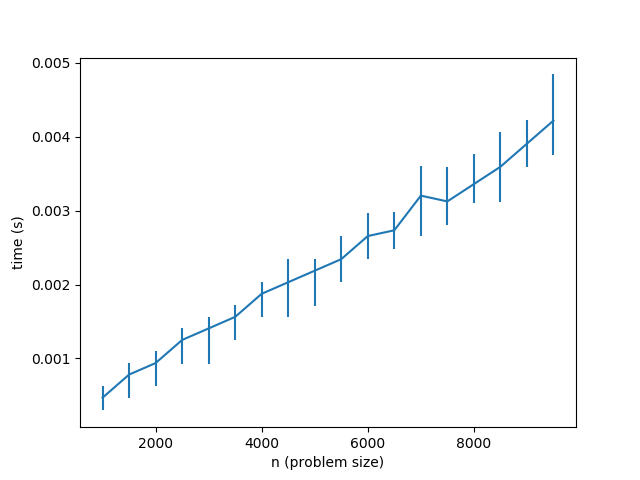
Author
(excuse the variable names: I followed the ones from the reference paper verbatim)
Sign up for free
to join this conversation on GitHub.
Already have an account?
Sign in to comment