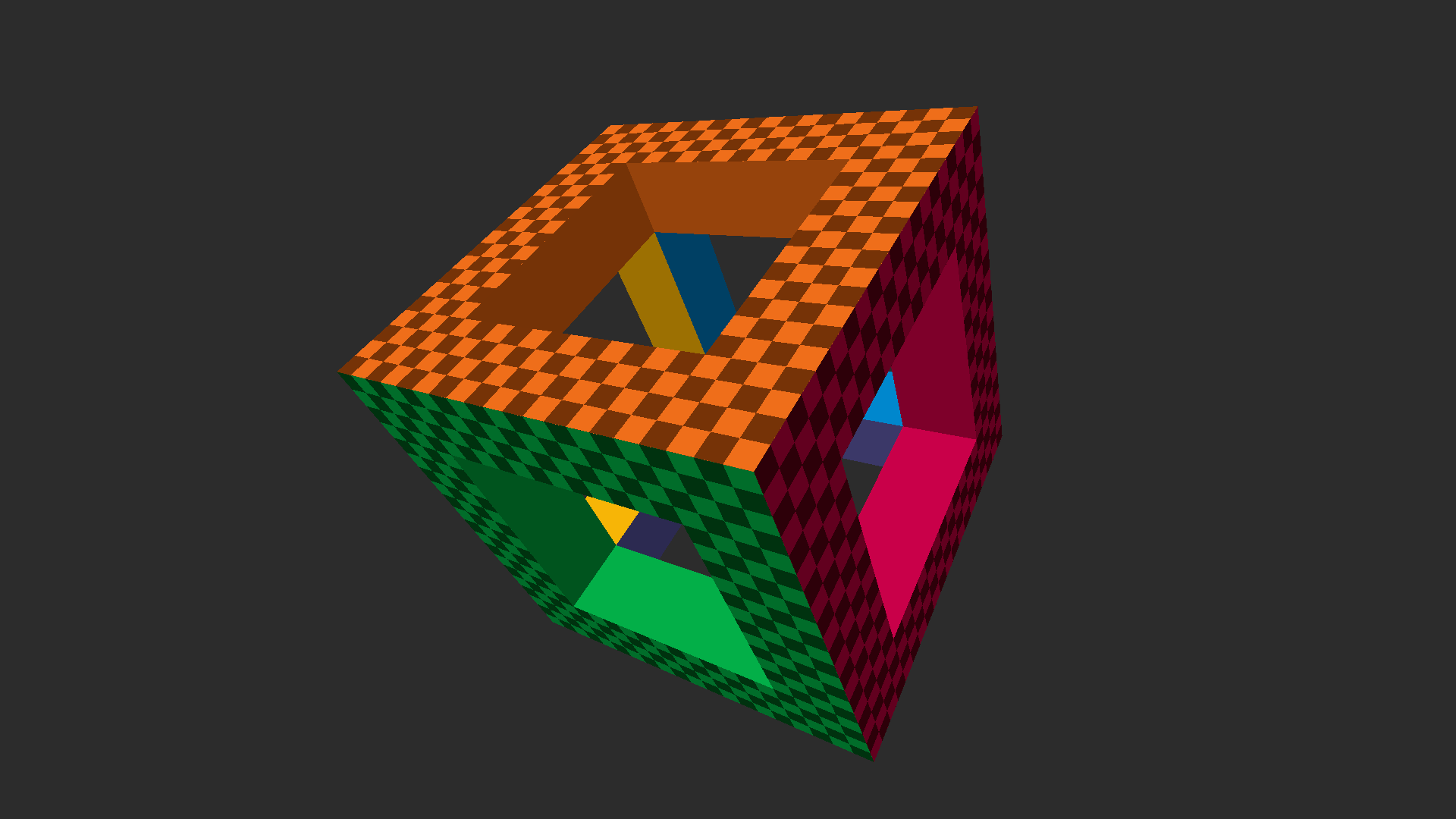
Minimal D3D11 reference implementation: An uncluttered Direct3D 11 setup + basic rendering primer and API familiarizer. Complete, runnable Windows application contained in a single function and laid out in a linear, step-by-step fashion that should be easy to follow from the code alone. ~200 LOC. No modern C++ / OOP or (other) obscuring cruft. View on YouTube
This file contains hidden or bidirectional Unicode text that may be interpreted or compiled differently than what appears below. To review, open the file in an editor that reveals hidden Unicode characters.
Learn more about bidirectional Unicode characters
| import React, { | |
| cloneElement, | |
| useState, | |
| useEffect, | |
| useRef, | |
| HTMLAttributes, | |
| ReactElement | |
| } from "react"; | |
| //////////////////////////////////////////////////////////////////////////////// |
This file contains hidden or bidirectional Unicode text that may be interpreted or compiled differently than what appears below. To review, open the file in an editor that reveals hidden Unicode characters.
Learn more about bidirectional Unicode characters
| /* eslint-disable jsx-a11y/accessible-emoji */ | |
| import React, { Suspense, useState } from "react"; | |
| import { unstable_scheduleCallback } from "scheduler"; | |
| import { unstable_createResource as createResource } from "react-cache"; | |
| import { | |
| Combobox, | |
| ComboboxInput, | |
| ComboboxList, | |
| ComboboxOption, | |
| ComboboxOptionText |
This file contains hidden or bidirectional Unicode text that may be interpreted or compiled differently than what appears below. To review, open the file in an editor that reveals hidden Unicode characters.
Learn more about bidirectional Unicode characters
| import * as React from 'react'; | |
| import { theme } from './theme'; | |
| import { ThemeProvider, createGlobalStyle } from './styled-components'; | |
| const GlobalStyle = createGlobalStyle` | |
| body { | |
| font-family: Times New Roman; | |
| } | |
| `; |
This file contains hidden or bidirectional Unicode text that may be interpreted or compiled differently than what appears below. To review, open the file in an editor that reveals hidden Unicode characters.
Learn more about bidirectional Unicode characters
| [Settings] | |
| ID = "Your_Site_ID" | |
| # Settings in the [build] context are global and are applied to all contexts unless otherwise overridden by more specific contexts. | |
| [build] | |
| # This is the directory to change to before starting a build. | |
| base = "project/" | |
| # NOTE: This is where we will look for package.json/.nvmrc/etc, not root. | |
| # This is the directory that you are publishing from (relative to root of your repo) |
This file contains hidden or bidirectional Unicode text that may be interpreted or compiled differently than what appears below. To review, open the file in an editor that reveals hidden Unicode characters.
Learn more about bidirectional Unicode characters
| /** | |
| * In our app, we have a few middleware that generate a string of HTML. | |
| * On occassion it's fine to just use dangerouslySetInnerHTML directly for | |
| * those, but that requires that you have a host node for the innerHTML. | |
| * | |
| * In certain scenarios (like tags in <head />), there's HTML that we need | |
| * to insert directly where it is. This component enables that because | |
| * we replace <raw-text> and </raw-text> with empty strings. Effectively | |
| * making whatever's between <raw-text> and </raw-text> inlined in place. | |
| * |
This file contains hidden or bidirectional Unicode text that may be interpreted or compiled differently than what appears below. To review, open the file in an editor that reveals hidden Unicode characters.
Learn more about bidirectional Unicode characters
| module.exports = { | |
| module: { | |
| rules: [ | |
| { | |
| test: /\.js$/, | |
| exclude: /node_modules/, | |
| use: { | |
| loader: "babel-loader" | |
| } | |
| } |
This file contains hidden or bidirectional Unicode text that may be interpreted or compiled differently than what appears below. To review, open the file in an editor that reveals hidden Unicode characters.
Learn more about bidirectional Unicode characters
| import React, { Component } from 'react'; | |
| import findByType from './findByType'; | |
| import css from './somestyle.css'; | |
| // We instantiate the Title sub-component | |
| const Title = () => null; | |
| class Article extends Component { | |
| // This is the function that will take care of rendering our Title sub-component | |
| renderTitle() { | |
| const { children } = this.props; | |
| // First we try to find the Title sub-component among the children of Article |
This file contains hidden or bidirectional Unicode text that may be interpreted or compiled differently than what appears below. To review, open the file in an editor that reveals hidden Unicode characters.
Learn more about bidirectional Unicode characters
| import React from 'react'; | |
| const findByType = (children, component) => { | |
| const result = []; | |
| /* This is the array of result since Article can have multiple times the same sub-component */ | |
| const type = [component.displayName] || [component.name]; | |
| /* We can store the actual name of the component through the displayName or name property of our sub-component */ | |
| React.Children.forEach(children, child => { | |
| const childType = | |
| child && child.type && (child.type.displayName || child.type.name); | |
| if (type.includes(childType)) { |
This file contains hidden or bidirectional Unicode text that may be interpreted or compiled differently than what appears below. To review, open the file in an editor that reveals hidden Unicode characters.
Learn more about bidirectional Unicode characters
| AccessModifierOffset: 2 | |
| AlignAfterOpenBracket: true | |
| AlignConsecutiveAssignments: true | |
| AlignConsecutiveDeclarations: true | |
| AlignEscapedNewlines: Right | |
| AlignOperands: true | |
| AlignTrailingComments: true | |
| AllowAllParametersOfDeclarationOnNextLine: true | |
| AllowShortBlocksOnASingleLine: false | |
| AllowShortCaseLabelsOnASingleLine: true |
