
Source audited: The White House post on X, published August 21, 2026, with its attached image.
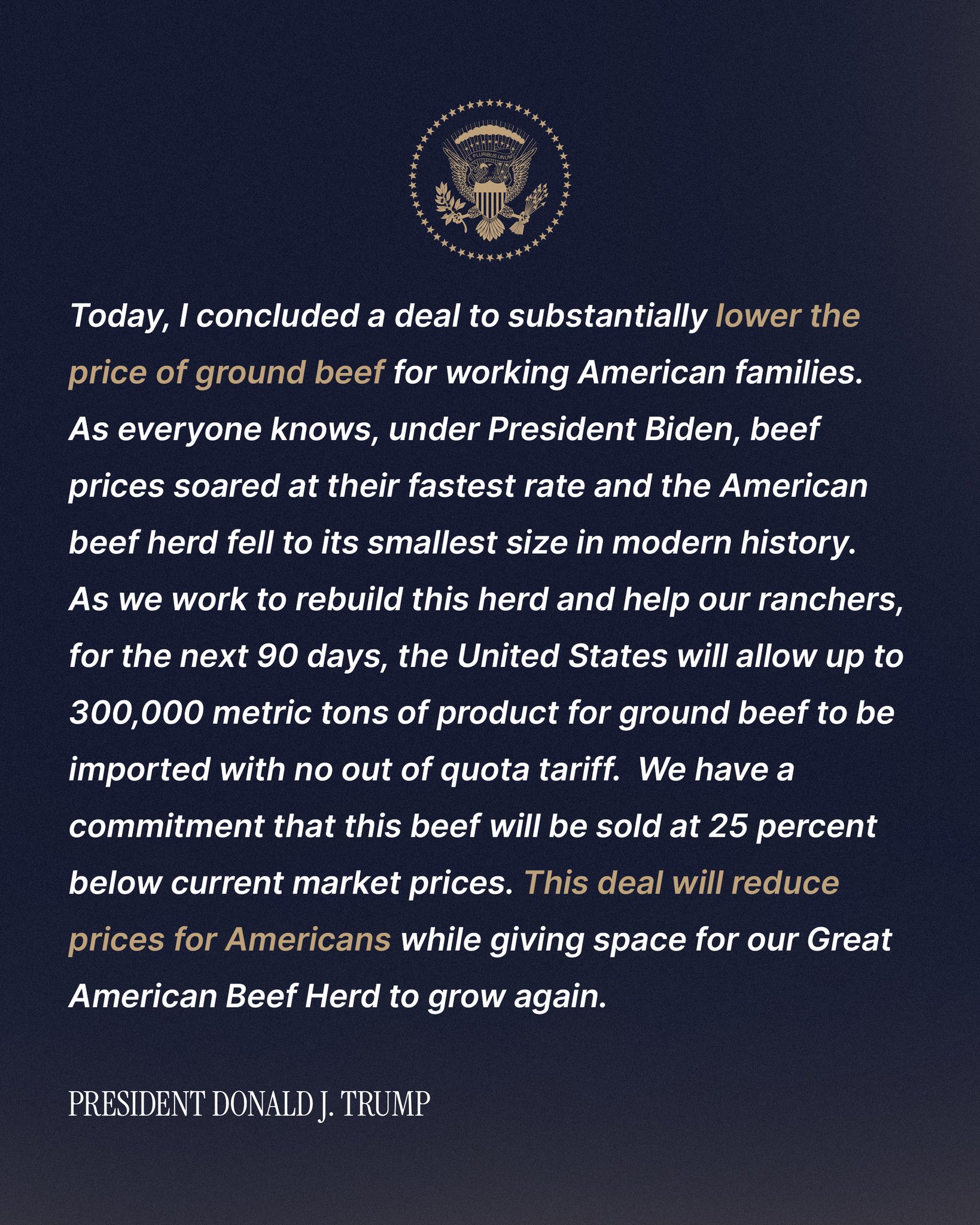
Decision the message is trying to move: belief that a completed deal has already substantially lowered ground-beef prices, and that the announced import policy will lower prices while helping rebuild the U.S. cattle herd.
Audit date: August 22, 2026.
Today, I concluded a deal to substantially lower the price of ground beef for working American families.
As everyone knows, under President Biden, beef prices soared at their fastest rate and the American beef herd fell to its smallest size in modern history.
As we work to rebuild this herd and help our ranchers, for the next 90 days, the United States will allow up to 300,000 metric tons of product for ground beef to be imported with no out of quota tariff. We have a commitment that this beef will be sold at 25 percent below current market prices. This deal will reduce prices for Americans while giving space for our Great American Beef Herd to grow again.
PRESIDENT DONALD J. TRUMP
Verdict: Misleading.
The post combines a real affordability problem, a real cattle-supply problem, and a real policy announcement with several claims that are presented more confidently than the evidence allows. Ground beef is expensive, and the U.S. herd is near a multi-decade low. But the post presents an announced future policy as a completed price reduction, gives no public details that would let anyone verify the claimed 25-percent discount, and uses a broad historical superlative that the available Bureau of Labor Statistics data do not support. The formal implementation instrument, participating exporters, pricing basis, enforcement mechanism, and retail pass-through were not identified in the sources checked as of August 22.
- The White House really did publish the post and image quoted above on August 21, 2026. The attached image contains the 90-day, 300,000-metric-ton, 25-percent language.
- Ground beef prices are high. The BLS average-price series for 100-percent ground beef was $6.885 per pound in July 2026, compared with $6.254 in July 2025 and $3.965 in January 2021. The series is not seasonally adjusted and measures a U.S. city average, not every product or store.
- The cattle supply is unusually tight. USDA NASS reported 86.155 million cattle and calves on U.S. farms on January 1, 2026, down 0.4 percent from January 1, 2025. Beef cows numbered 27.607 million, down 1 percent year over year. USDA has separately described the national herd as being at a 75-year low.
- The tariff-rate-quota mechanism is real. USDA explains that imported beef generally enters under a lower in-quota duty and faces a substantially higher out-of-quota duty after the applicable quota is filled. USDA also explains that many imports are lean trimmings used to blend with domestic fat for ground beef.
- The administration has already taken a narrower, documented beef-import action. The February 2026 proclamation increased the 2026 in-quota quantity for specified lean beef trimmings by 80,000 metric tons, allocated to Argentina in four quarterly tranches. That is not the same as the August post's proposed 300,000 metric tons over 90 days.
- The White House's announced mechanism is economically plausible in a narrow sense: removing an out-of-quota tariff could reduce the landed cost of some eligible imports. That does not establish a 25-percent reduction in the price paid by a household at a grocery store.
- Read as an absolute historical superlative, “beef prices soared at their fastest rate” is contradicted by the BLS data. In the 100-percent ground-beef series, the largest year-over-year increase in the available historical pull was 22.83 percent in December 2011, compared with 20.02 percent in April 2022. In the broader all-uncooked-ground-beef series, the historical maximum was 19.41 percent in October 2014, compared with 16.28 percent in April 2022. The narrower claim that prices rose rapidly during the Biden years is supported; the unqualified “fastest rate” claim is not.
- “The American beef herd” is not a defined statistical series in the post. It could mean all cattle and calves, beef cows, or another supply measure. USDA NASS's January 2026 all-cattle figure is a post-1951 low, but the NASS historical chart runs back to 1867 and visibly contains much smaller inventories in the nineteenth century. The July 2026 beef-cow figure was 28.5 million, down 1 percent from July 2025; an independent Farm Bureau analysis describes that as the smallest July beef-cow inventory in its series, which begins in 1973. The phrase is therefore directionally grounded but materially underspecified.
- The price increase is a fact; the blame assignment is not established by the timing. USDA identifies drought, wildfires, herd liquidation, feed and forage constraints, restrictions related to New World screwworm, strong demand, and the cattle cycle as relevant factors. Saying prices rose “under President Biden” supplies a timeline, not a demonstrated causal estimate of Biden administration responsibility.
- The August action was announced, not yet demonstrated as implemented. CNBC, ABC News, and Roll Call all reported that the White House said a formal executive order would be signed within two weeks. As of this audit, the Federal Register search for beef tariff actions showed the February 13 beef proclamation as the latest beef-specific implementing action, and the CBP quota materials did not show an August 21 bulletin for this plan. That is evidence about the public record checked, not proof that no private agreement existed.
- The 25-percent figure has no verifiable denominator in the public announcement. “Current market prices” could mean an exporter price, a wholesale price, an import price, or a retail price. The post names no exporters, importers, retailers, product specifications, contracts, enforcement mechanism, or geographic scope. A 25-percent reduction in the price of imported lean trimmings would not automatically become a 25-percent reduction in a shopper's package of ground beef.
- The short-term and long-term goals can conflict. More imported lean product may ease a short-term supply constraint, especially for ground-beef blending. But if below-market imports reduce the price signal received by domestic ranchers, they could weaken the incentive to retain heifers and rebuild the herd. That is a policy risk raised by rancher groups and farm-state lawmakers, not a settled prediction.
- The scale is concrete but not self-interpreting. Three hundred thousand metric tons is about 661.4 million pounds. Compared with USDA's July 2026 forecast of 25.288 billion pounds of total U.S. beef production, that is about 2.62 percent of annual production. The comparison is only a rough scale check because the policy concerns product intended for ground-beef production, not all beef output.
- Authority and prestige: The presidential seal, first-person voice, and declarative tone invite readers to treat an assertion as a verified result.
- Political contrast: “Under President Biden” links a real price and supply problem to a political opponent without presenting a causal analysis, while omitting the multiple supply, disease, climate, and demand factors identified by USDA.
- Completion framing: “I concluded a deal” and “this deal will reduce prices” make a future, conditional outcome feel completed and observed.
- Pseudo-precision: “300,000 metric tons,” “90 days,” and “25 percent” sound audit-ready, but the post supplies no product definition, comparison market, participating firms, enforcement terms, or pass-through evidence.
- Positive-sum framing: The message promises cheaper food and a stronger domestic herd at the same time, without acknowledging the possible tension between short-term import competition and long-term producer incentives.
- Emotional loading: “working American families,” “our ranchers,” and “Great American Beef Herd” connect an economic proposal to family, patriotism, and group identity. Those values may be legitimate, but they do not verify the factual claims.
-
Material factual claim: current ground-beef prices.
- Source of truth: BLS average-price series for ground beef.
- URL and access date: APU0000703112, accessed August 22, 2026.
- Scope and result: Supports the reported price level and the sharp increase. It is a U.S. city average for 100-percent ground beef, not a universal retail price.
-
Material factual claim: beef prices rose at their fastest rate under Biden.
- Source of truth: BLS monthly average-price observations for the 100-percent ground-beef and all-uncooked-ground-beef series.
- URL and access date: BLS 100-percent ground beef series and BLS all-uncooked-ground-beef series, accessed August 22, 2026.
- Scope and result: Supports a large increase during the Biden years but contradicts an unqualified all-time “fastest” reading. The comparison uses monthly year-over-year changes and states the series definition.
-
Material factual claim: the herd reached its smallest size in modern history.
- Source of truth: USDA NASS Cattle reports and NASS historical inventory chart.
- URL and access date: January 2026 Cattle report, July 2026 Cattle report, and NASS historical chart, accessed August 22, 2026.
- Scope and result: Supports a multi-decade low and a historically small beef-cow inventory in the relevant monthly series. It does not support the literal claim that the all-cattle inventory is the smallest in the full historical chart, and the post does not identify the population or timeframe.
-
Material factual claim: up to 300,000 metric tons can enter for 90 days without an out-of-quota tariff.
- Source of truth: Presidential action, Federal Register publication, HTSUS modification, and CBP quota implementation materials.
- URL and access date: CBP quota overview, CBP quota bulletins, and Federal Register beef-tariff search, accessed August 22, 2026.
- Scope and result: The sources establish how a change would be implemented and show the February beef action. They do not establish a published implementing instrument for the August 300,000-metric-ton plan as of the audit date. News reports establish that the White House announced the plan and said a formal order was forthcoming.
-
Material factual claim: the beef will be sold 25 percent below current market prices.
- Source of truth: The underlying agreement or enforceable contracts, plus a defined wholesale or retail price series.
- URL and access date: Original White House post, accessed August 22, 2026.
- Scope and result: The post supports only that the President made this commitment. It does not disclose the agreement, parties, price definition, enforcement terms, or retail pass-through, so it cannot independently settle the claim.
-
Material factual claim: the deal will lower prices and help rebuild the herd.
- Source of truth: An implemented policy record, product-level transaction data, retail price data, and a properly specified supply-response analysis.
- URL and access date: USDA ERS Cattle and Beef sector overview, USDA ERS Food Price Outlook, and CNBC's report on the announcement, accessed August 22, 2026.
- Scope and result: The sources support the supply problem and explain why imports may affect ground-beef supply. They do not yet demonstrate the promised retail price reduction or the long-term herd-rebuilding effect.
| Claim | Literal wording | Implied conclusion | Evidence | Tier | Finding | Limitation | Confidence |
|---|---|---|---|---|---|---|---|
| Prices are high | “substantially lower the price of ground beef” | A pressing affordability problem exists | BLS average price: $6.885/lb in July 2026; USDA ERS price outlook | 1 | Supported narrowly | Average-price series is not every product or store | High |
| Prices rose fastest under Biden | “under President Biden, beef prices soared at their fastest rate” | Biden bears responsibility for an unprecedented price surge | BLS monthly series: 20.02% year over year in Apr. 2022 versus historical maxima of 22.83% in Dec. 2011 and 19.41% in Oct. 2014, depending on series | 1 | Misleading, and false as an absolute historical superlative | “Fastest” and “beef prices” are undefined | High |
| Herd is exceptionally small | “fell to its smallest size in modern history” | The policy is correcting an unprecedented collapse | USDA NASS: 86.155m all cattle and calves in Jan. 2026; 27.607m beef cows; USDA says 75-year low; NASS chart begins in 1867 | 1 | Complicated | Population and timeframe are omitted | High |
| Import relief was announced | “for the next 90 days ... up to 300,000 metric tons” | A tariff-free supply intervention is already in force | White House post; CNBC, ABC News, and Roll Call report a formal order was still forthcoming | 1/3 | Unsupported as an implemented fact; supported as an announcement | Federal Register and CBP implementation record had not caught up as of Aug. 22 | High |
| Beef will be 25% cheaper | “this beef will be sold at 25 percent below current market prices” | Shoppers will see a 25% reduction | Presidential statement only; no named parties, contract, benchmark, or enforcement terms | 4 | Unsupported | “Current market prices” and pass-through level are undefined | High |
| The deal will lower prices and rebuild the herd | “This deal will reduce prices ... while giving space ... to grow again” | The policy has both immediate and long-term benefits | USDA supply data; CNBC economist said price impact remained to be seen; rancher groups warned of incentive effects | 1/2/3 | Unknown and complicated | Future outcome requires implementation and observed data | Medium |
Source-tier key: 1 = primary or official evidence; 2 = independent synthesis or expert analysis; 3 = secondary reporting; 4 = interested-party statement.
The historical rate comparison uses the BLS public API observations for APU0000703112 and APU0000FC1101, queried in year windows no longer than 20 years and deduplicated by year-month. A 12-month change is calculated as (current month / same month one year earlier) - 1. October 2025 is excluded where BLS marks the observation unavailable because of the lapse in appropriations. The scale calculation uses 300,000 metric tons multiplied by 2,204.62262185 pounds per metric ton, or approximately 661.4 million pounds.
Do not repeat the claim as “ground-beef prices have already fallen 25 percent.” Treat it as a policy announcement and wait for three independent checks: (1) the signed order or proclamation and the corresponding Federal Register or CBP implementation notice; (2) the named exporters, product definition, benchmark, and enforceable terms behind the 25-percent promise; and (3) actual BLS and USDA retail-price observations during and after the 90-day window. The smallest honest shareable summary is: the White House announced temporary tariff relief and promised a discount, but the public evidence does not yet show that the policy has lowered retail prices or will rebuild the herd.
- White House post on X
- Attached image
- White House February 2026 fact sheet
- White House February 2026 proclamation
- Federal Register: Ensuring Affordable Beef for the American Consumer
- USDA NASS: January 2026 cattle inventory
- USDA NASS: July 2026 cattle inventory
- USDA NASS: historical January 1 cattle inventory chart
- USDA ERS: Cattle and Beef, sector at a glance
- USDA ERS: Food Price Outlook, 2026
- USDA FAS: Reviewing tariff-rate quotas for U.S. beef imports
- BLS: 100-percent ground beef average price series
- BLS: all uncooked ground beef average price series
- CNBC: report on the August 21 announcement
- ABC News: report on the August 21 announcement
- Roll Call: report on the plan and forthcoming executive order
This audit evaluates the claims and evidence, not the speaker's motive or sincerity. “Accessed August 22, 2026” records the snapshot used for this assessment.