
-
-
Save nmoinvaz/26daed85a714e7c55cb29e61a3ee82fe to your computer and use it in GitHub Desktop.
| import matplotlib.pyplot as plt | |
| import numpy as np | |
| import random | |
| import timeit | |
| import time | |
| import math | |
| import argparse | |
| import zlib | |
| from random import seed | |
| import struct | |
| parser = argparse.ArgumentParser(description='Hash algorithm testing') | |
| parser.add_argument('--file', help='File to test', default=None, action='store', required=False) | |
| args, unknown = parser.parse_known_args() | |
| print("Arguments - Known/Unknown") | |
| print(args) | |
| print(unknown) | |
| def crc32_hash(val): | |
| return zlib.crc32(val) | |
| def zlib_hash(val): | |
| # (h = (((h)<<s->hash_shift) ^ (c)) & s->hash_mask) | |
| return ((val & 0xff) << 8) ^ ((val >> 16) & 0xff) | |
| def zlib_ng_hash(val): | |
| return ((3483 * ((val) & 0xff)) + | |
| (23081 * (((val) >> 8) & 0xff)) + | |
| (6954 * (((val) >> 16) & 0xff)) + | |
| (20947 * (((val) >> 24) & 0xff))) | |
| def knuth_hash(val): | |
| return ((val * np.uint32(2654435761)) >> (32 - 15)) | |
| def knuth_hash_mod(val): | |
| val ^= val >> (32 - 15) | |
| return ((val * np.uint32(2654435761)) >> (32 - 15)) | |
| def fib_hash(val): | |
| return (np.uint64(val) * np.uint64(11400714819323198485)) >> 12 | |
| def fib_hash_mod(val): | |
| val = np.uint64(val) | |
| val ^= val >> (12) | |
| return (val * np.uint64(11400714819323198485)) >> 12 | |
| hashes = [ | |
| {"name": "crc32", "func": crc32_hash, "color": "darkblue"}, | |
| {"name": "zlib-ng", "func": zlib_ng_hash, "color": "darkslateblue"}, | |
| {"name": "knuth", "func": knuth_hash, "color": "mediumorchid"}, | |
| {"name": "knuth-mod", "func": knuth_hash, "color": "plum"}, | |
| {"name": "fib", "func": fib_hash, "color": "palevioletred"}, | |
| {"name": "fib-mod", "func": fib_hash, "color": "pink"} | |
| ] | |
| max_wsize = 32*1024 | |
| seed(time.time()) | |
| int_vals = [] | |
| if not args.file: | |
| # Get random values to hash | |
| for i in range(0, max_wsize): | |
| val = np.uint32(random.getrandbits(32)) | |
| int_vals.append(val) | |
| else: | |
| # Read data from binary file | |
| with open(args.file, "rb") as f: | |
| j = 0 | |
| while True: | |
| buf = f.read(4) | |
| if not buf or len(buf) < 4: | |
| break | |
| i = np.frombuffer(buf, dtype=np.uint32) | |
| int_vals.append(i) | |
| j += 1 | |
| if time.time() % 2 == 0: | |
| print("reads ints from input " + str(j) + "..") | |
| f.close() | |
| print("total number of integers to hash " + str(len(int_vals))) | |
| # Get collision map | |
| def gen_collision_map(values, hash_func): | |
| collision_map = {} | |
| for i in range(0, len(values)): | |
| h = int(hash_func(values[i]) % (max_wsize)) | |
| if h not in collision_map: | |
| collision_map[h] = [] | |
| if values[i] not in collision_map[h]: | |
| collision_map[h].append(values[i]) | |
| return collision_map | |
| def flatten_collision_map(collision_map): | |
| flat_collision_map = np.zeros(max_wsize, dtype=np.uint32) | |
| max_collisions = 0 | |
| total_collisions = 0 | |
| for (h, v) in collision_map.items(): | |
| collisions = 0 | |
| hashes_in_bucket = len(v) | |
| if hashes_in_bucket >= 1: | |
| collisions = hashes_in_bucket | |
| flat_collision_map[h] = collisions | |
| if max_collisions < hashes_in_bucket: | |
| max_collisions = hashes_in_bucket | |
| total_collisions += collisions | |
| return (flat_collision_map, max_collisions, total_collisions) | |
| def gen_heat_map(collision_map): | |
| heat_map = [] | |
| for i in range(0, len(collision_map)): | |
| row = int(i % math.sqrt(max_wsize)) | |
| if len(heat_map) <= row: | |
| heat_map.append([]) | |
| heat_map[row].append(collision_map[i]) | |
| return heat_map | |
| max_collisions = 0 | |
| for hash in hashes: | |
| # Calculate collision map and time spent | |
| start = time.time() | |
| hash["collision_map"] = gen_collision_map(int_vals, hash["func"]) | |
| end = time.time() | |
| hash["flat_collision_map"], hash["max_collisions"], hash["total_collisions"] = \ | |
| flatten_collision_map(hash["collision_map"]) | |
| print(hash["name"] + " hash time " + str(end - start) + "s") | |
| print(hash["name"] + " max collisions per hash " + str(hash["max_collisions"])) | |
| print(hash["name"] + " total collisions " + str(hash["total_collisions"])) | |
| # Get the maximum number of collisions per hash out of all the | |
| # hashes, this is used to make the collision count array the same | |
| # length for graphing | |
| if hash["max_collisions"] > max_collisions: | |
| max_collisions = hash["max_collisions"] | |
| if max_wsize <= 16*1024: # Max image size | |
| # Generate heat map | |
| hash["heat_map"] = gen_heat_map(hash["flat_collision_map"]) | |
| # Show heat map | |
| fig, ax = plt.subplots() | |
| im = ax.imshow(np.real(hash["heat_map"])) | |
| ax.set_title(hash["name"] + " distribution heat map") | |
| fig.tight_layout() | |
| plt.show() | |
| print("max collisions for all hashes " + str(max_collisions)) | |
| for hash in hashes: | |
| # Count the number of collisions per hash | |
| hash["collision_count"] = np.zeros(max_collisions, dtype=int) | |
| print("Flat collision map for " + hash["name"]) | |
| #print(np.matrix(hash["flat_collision_map"])) | |
| #np.savetxt(hash["name"] + "-flat.csv", hash["collision_count"], delimiter=",") | |
| for i in range(0, len(hash["flat_collision_map"])): | |
| hash_bucket_collisions = hash["flat_collision_map"][i] | |
| if hash_bucket_collisions > 0: | |
| hash["collision_count"][hash_bucket_collisions-1] += 1 | |
| # Show multi-bar graph using hash collision counts | |
| bar = 0 | |
| width = 0.15 | |
| widths = [] | |
| fig, ax = plt.subplots() | |
| for hash in hashes: | |
| if bar == 0: | |
| widths = np.arange(len(hash["collision_count"])) | |
| else: | |
| widths = [x + width for x in widths] | |
| ax.bar(widths, hash["collision_count"], color=hash["color"], width=width, label=hash["name"]) | |
| bar += 1 | |
| x_labels = [] | |
| for i in range(0, max_collisions): | |
| x_labels.append(i+1) | |
| x = np.arange(max_collisions) | |
| ax.set_xticks(x + width + width/2) | |
| ax.set_xticklabels(x_labels) | |
| ax.set_xlabel('number of collisions') | |
| ax.set_ylabel('number of hash buckets') | |
| ax.legend() | |
| fig.tight_layout() | |
| plt.show() |


Looks like that 24 corresponds to MIN_MATCH=3 from the code.
#define UPDATE_HASH(s, h, val) \
    h = ((val * 2654435761U) >> ((MIN_MATCH * 8) - s->hash_bits));
I am unsure whether that is the right bitshifting for the use-case, but it might be, I haven't played a lot with bit shifts.
@Dead2 We want as many significant bits for the hash as possible... for 16-bit variable, only 1 bit is wasted. Because we are actually hashing 4 bytes, not 3 bytes, it needs to be 4 * 8 = 32.

@mtl1979 I have updated the value, but I don't know that it makes much of a difference.
@Dead2 I don't know that fibonacci hash is too dissimilar to knuth except it uses 64-bits.
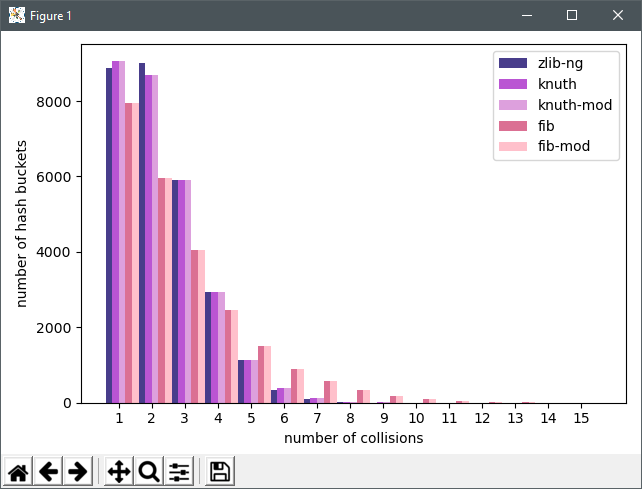
In this test hash table size is 16k:
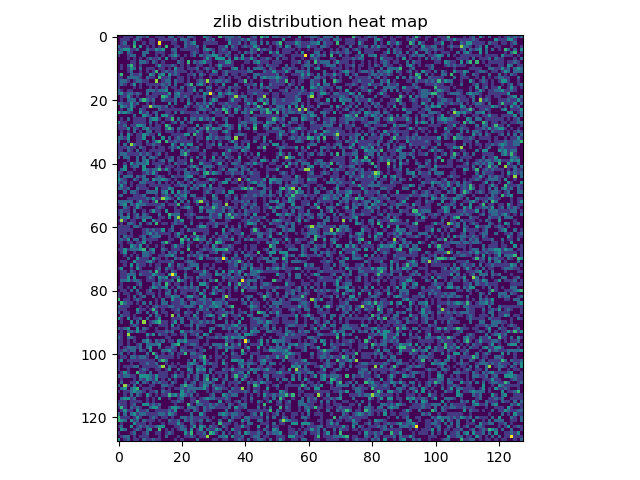
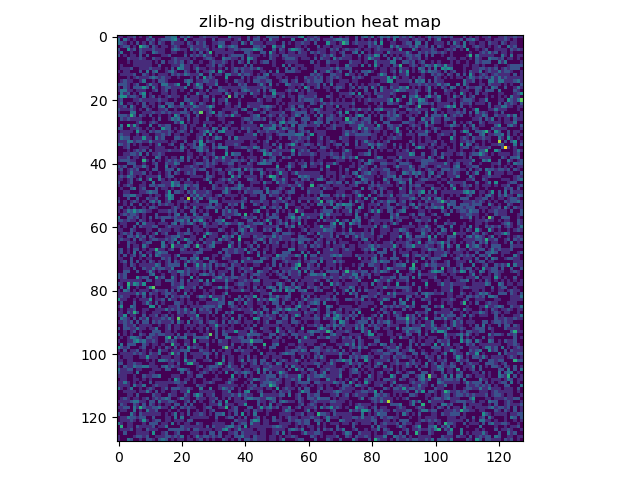
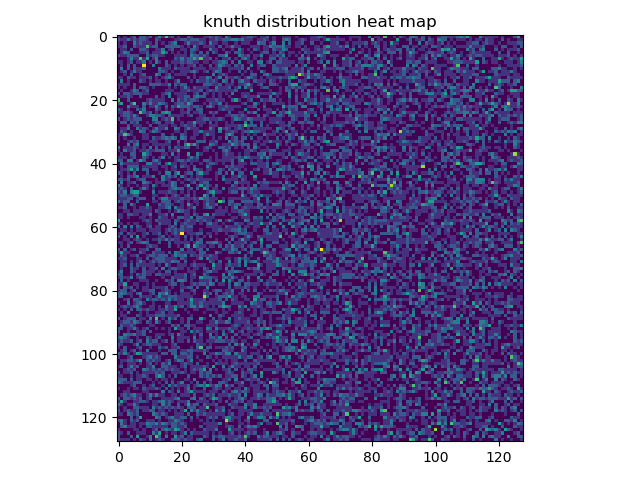
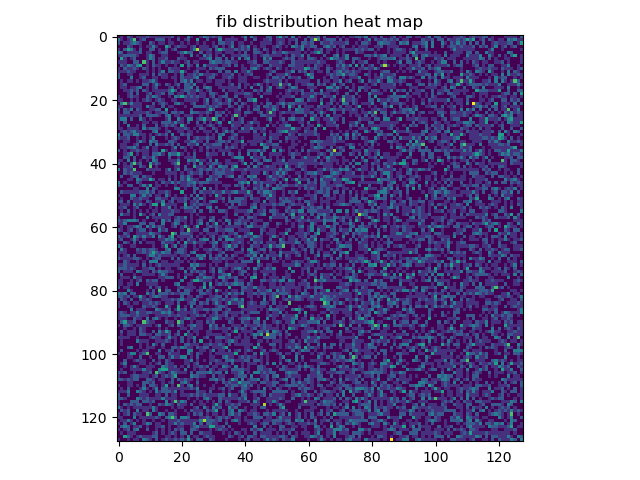
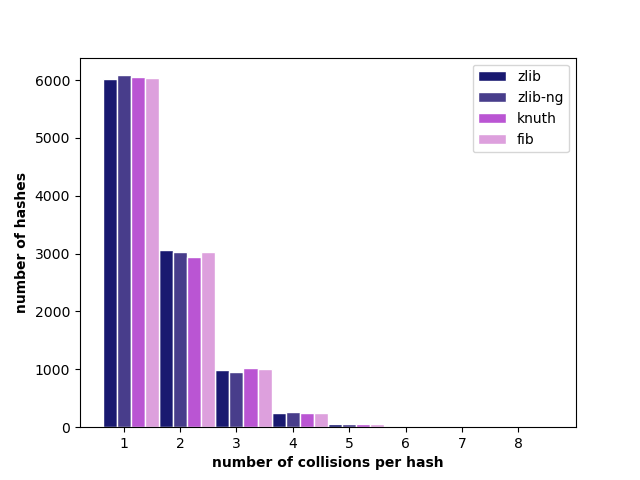
They seem to perform about the same on random integer values. It is possible they may perform differently on different sets of data.
It is also possible that we don't see much of a difference between the hash functions, because our hash table is only 32k. When I increase the hash table size to 128k the difference is more apparent, but this doesn't apply to us.
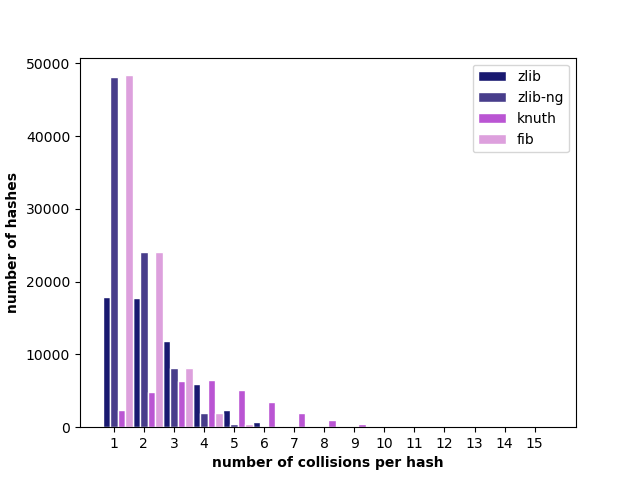
Hmm, we might want to test with 64k hash tables too if we go for a static size, to see if that improves compression speed if memory is not at a premium.
I ran a test and didn't see a significant performance increase. However, my performance tests are not as exact as yours.
So the heat maps are essentially useless for my input data - which is random values. As long as my random function is truly random then the heat map will also have good distribution. The heat maps would tell us if there is a significant distribution degrade, say if I only used the first byte of the integer for the hash, then the heat map would look very poor but I don't expect to use such a hash method. What matters here the most is the number of collisions from the hash.
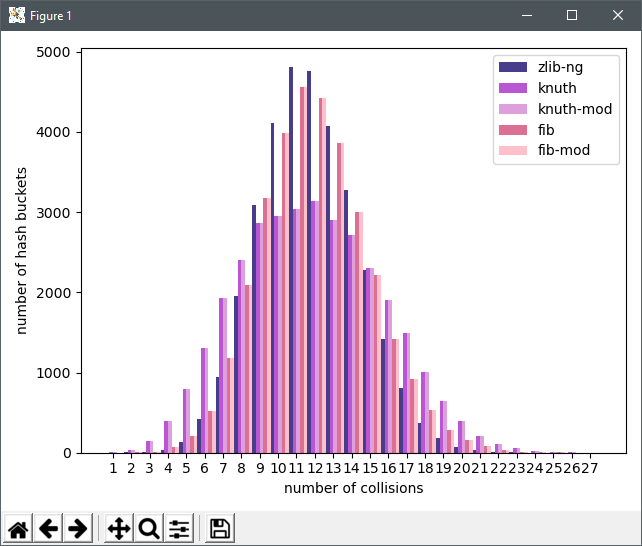
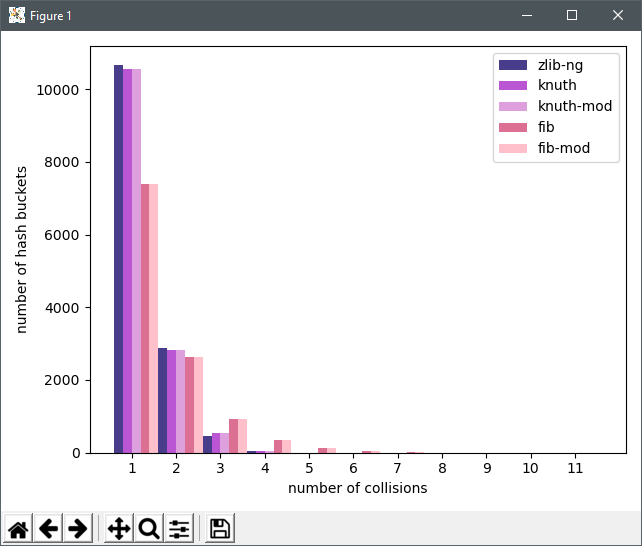
I have updated my script and here are some results with 32k hash table size:
earth.bmp
lcet10.txt
asl16.nii
dickens
Having the hash shift mod makes no difference to the algorithm.
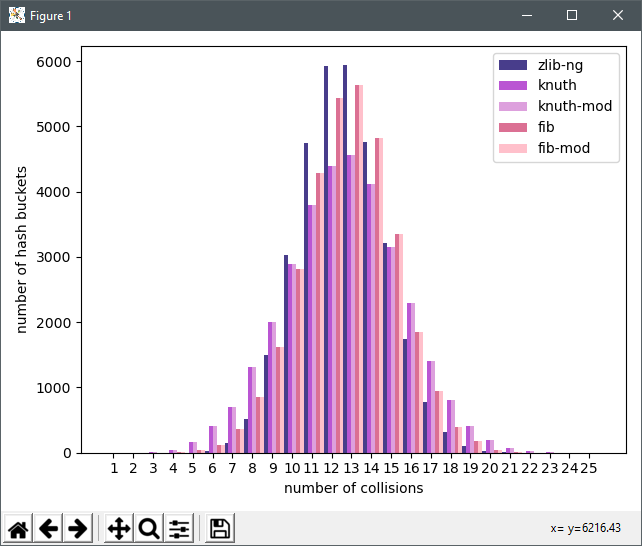
The graph charts the number of hash buckets that had a certain number of collisions. The best hash algorithm will have a higher number of hash buckets on with lower number of collisions.
So in the graph, the best algorithm will have higher number of buckets (y-axis) as the number of collisions per hash bucket (x-axis) decreases. I suspect that knuth will perform the best, of course it may vary due to type of input data.
I did a test on asl16.ni that is in pigz-bench-python corpus.
05/09/2020  01:36 AM        10,209,230 asl16.nii-crc32.gz
05/09/2020  01:42 AM        10,209,251 asl16.nii-knuth-32.gz
05/09/2020  03:55 AM        10,209,263 asl16.nii-fib-mod.gz
05/09/2020  01:37 AM        10,212,436 asl16.nii-ng.gz
05/09/2020  01:35 AM        10,315,591 asl16.nii-knuth-24.gz
05/09/2020  01:39 AM        10,377,594 asl16.nii-hashshift.gz
05/09/2020  03:56 AM        10,571,103 asl16.nii-fib.gz
03/26/2020  09:47 PM        19,071,328 asl16.nii
knuth32 is (32 - s->hash_bits)
knuth24 is ((MIN_MATCH * 8) - s->hash_bits)
hashshift is the weird h = (s->ins_h = ((s->ins_h << s->hash_shift) ^ ((val) >> ((MIN_MATCH - 1) * 8))) & s->hash_mask)
Also it appears fib-mod does make a difference, just not in python - thou it is still not significantly better than knuth.
Shouldn't line 13 be
return (val * 2654435761) >> (32-15)?